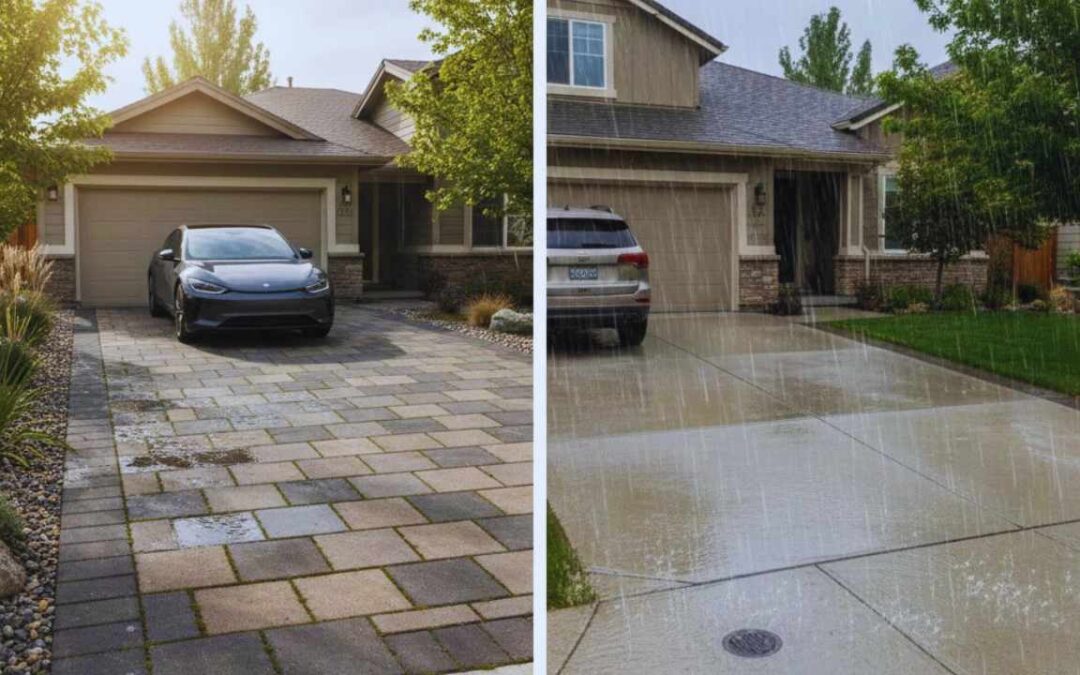
When homeowners in St. Louis start planning a new driveway, it’s not just about the look or upfront cost it’s about how that driveway will handle real Missouri conditions year after year. You’ve probably seen cracked slabs, sunken corners, or puddles forming right where your car should go. That’s not bad luck. It’s what happens when materials can’t stand up to freeze–thaw cycles, saturated clay soils, or the kind of heavy spring rains that hit this region hard.
A permeable paver driveway is a surface built using interlocking pavers designed to let water pass through into a drainage base underneath. In contrast, a concrete driveway is a solid, rigid slab that sheds water across the surface and into nearby runoff channels or soil. Both are common across the St. Louis area but how they perform long-term depends on much more than appearance.
This guide isn’t here to tell you what’s cheaper or trendier. It’s written to help you understand which material actually holds up better in Missouri’s challenging conditions. We’ll break down the three biggest local stressors:
-
Freeze–thaw cycles that expand and contract surfaces all winter
-
Clay-heavy subsoils that swell with moisture and shift under load
-
Frequent heavy rainfall that tests every inch of driveway drainage
By the end, you’ll have a clear, expert-level understanding of how permeable pavers and concrete compare not in theory, but in practice, right here in St. Louis.
The St. Louis Shortcut Answer (Before the Deep Dive)
If you’re skimming for a quick verdict before digging into drainage mechanics or driveway engineering here’s how these two surfaces perform under real Missouri conditions.
-
Drainage performance: Permeable pavers handle runoff better. They allow water to pass through the surface and into the ground, helping prevent puddling near foundations especially important on sloped or clay-heavy properties.
-
Winter durability: Permeable pavers flex; concrete cracks. Freeze–thaw cycles are brutal in St. Louis. While concrete is rigid and prone to surface scaling, pavers shift slightly and reset without major damage.
-
Repair flexibility: Pavers win for spot fixes. A single damaged paver can be pulled and replaced without affecting the whole surface. Cracked concrete usually means patching or pouring again often with poor visual results.
-
Long-term cost efficiency: Pavers typically cost more up front, but less over time. Their durability and repairability help avoid the bigger expenses tied to slab failures, heaving, or water damage.
-
Cheapest to install upfront: Concrete still leads on price. If immediate budget is the main concern, concrete’s lower material and labor costs are hard to beat just be ready for more long-term maintenance.
This quick snapshot gives you a starting point. But if you want to understand why these differences matter in a place like St. Louis where the soil shifts, the weather turns fast, and drainage can make or break a home’s foundation the rest of this guide is where the real clarity lives.
Why Missouri Weather Changes How Driveways Perform
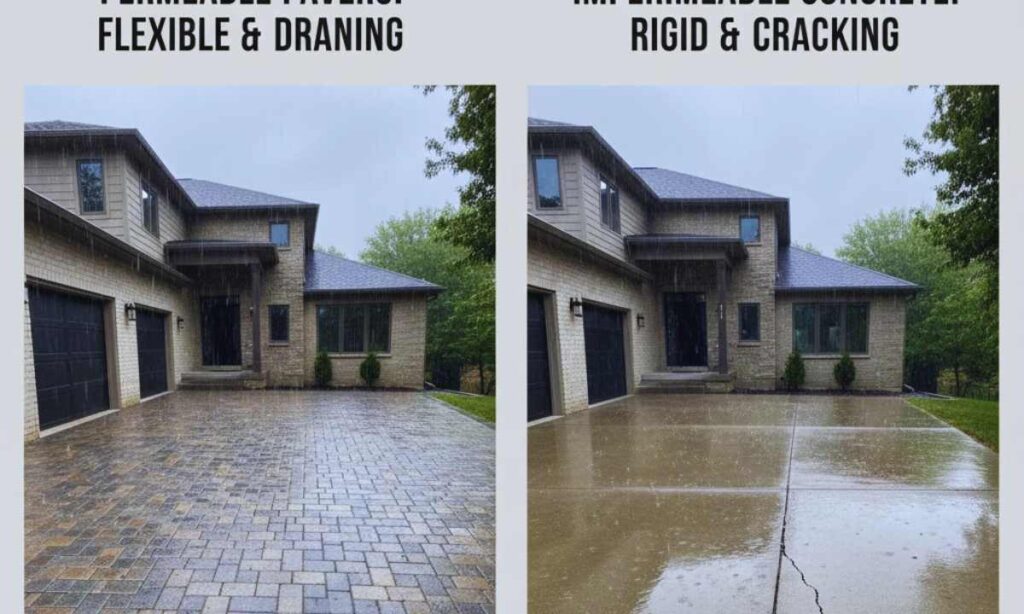
Driveways in St. Louis don’t just crack because they’re old. They fail because the ground underneath them is always moving. Between heavy spring rains, winter freeze-ups, and the kind of clay soil we have across this region, most materials are under constant stress from day one. This section walks through what’s really happening and why some driveways give out faster than others.
How Freeze–Thaw Cycles Stress Driveway Materials
Here’s what happens every winter. Water seeps into the driveway surface, then the temperature drops below freezing. That water turns to ice and expands. The surface pushes up, shifts, or cracks. Then it thaws and settles again. You get this cycle day after day for months.
Concrete slabs don’t move easily. They’re rigid and wide. So when the pressure builds, it has nowhere to go but out and that’s where cracks start. Over time, you’ll see spalling, scaling, or chunks breaking off. It doesn’t matter how new the slab is. Freeze–thaw hits everything eventually.
Permeable pavers don’t react the same way. Each paver sits on a flexible base and has space between units. That setup lets the surface flex and move slightly as the ground shifts beneath it. Instead of cracking, it adjusts. That’s why paver systems usually come out of winter with minimal damage even when temps swing hard.
Clay Soil Expansion and Drainage Challenges in St. Louis
Now let’s talk about what’s underneath. Most of the region from Florissant to Oakville sits on clay-rich subsoil. When clay gets wet, it swells. When it dries out, it shrinks and hardens. That movement doesn’t just happen once a year. It happens constantly. And it puts real pressure on anything built above it.
When a driveway sits on this kind of soil without proper drainage, the surface starts shifting. Corners lift. Panels crack. Water pools. That’s not just cosmetic. It’s a sign that the ground underneath is pushing back harder than the surface can handle. The other issue is hydrostatic pressure. If water collects under a slab and has no place to go, it pushes up. That’s how you get mid-slab lifting or cracks forming out of nowhere especially after a heavy storm or snowmelt.
A permeable paver system is built to handle that kind of environment. The base is made of open-graded stone, not packed dirt. Water drains through the joints, filters down, and moves away from the surface. That takes the pressure off both the driveway and the foundation nearby. I
f your house sits on a slope or near a low-lying street, that difference really matters. This is why we see so many concrete driveways fail early in places like Ballwin, Webster Groves, and anywhere near the floodplain. The soil, the rain, and the temperature shifts all add up and most slabs just aren’t built for it.
What Is a Permeable Paver Driveway?
If you’ve only seen traditional concrete slabs around your neighborhood, the idea of a driveway that water can soak through might sound risky. But a permeable paver driveway is a surface made from individual concrete or stone pavers, spaced to allow water to drain between them and into the ground below. It’s not a soft or loose surface it’s solid underfoot, but designed to manage moisture in a smarter way.
These systems are engineered to handle heavy loads while solving common drainage problems that St. Louis homeowners deal with year after year.
How Permeable Paver Systems Manage Water
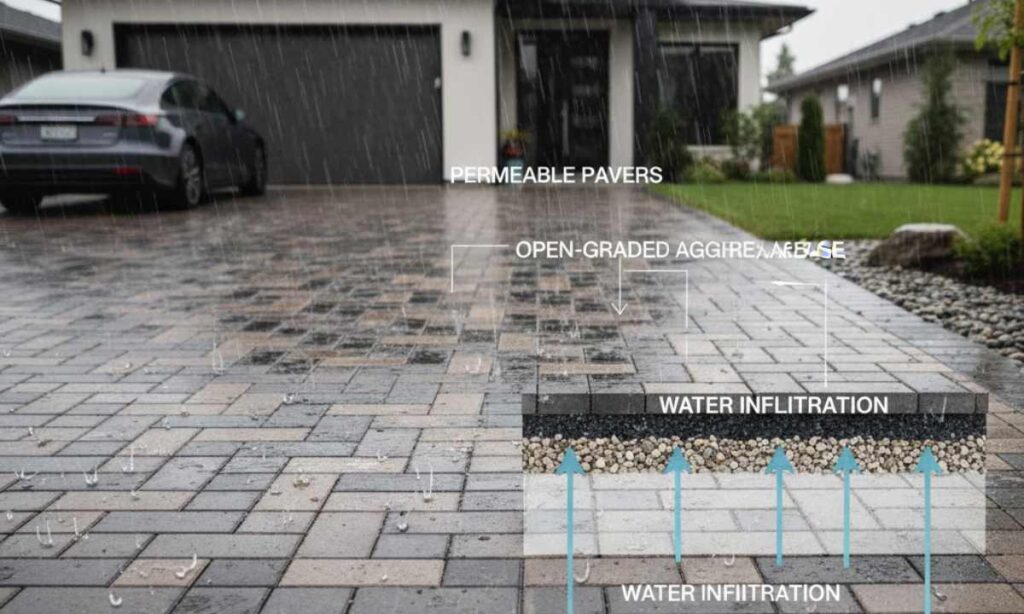
The pavers themselves are typically made from concrete, brick, or stone. They’re spaced slightly apart and laid on a base made from open-graded aggregate, not packed soil or sand. This layered base acts like a sponge and a filter at the same time letting water pass through and move away from the surface.
Open-graded aggregate is crushed stone that leaves air gaps between pieces. It doesn’t compact the way dirt does, which gives water a clear path to soak in and filter down instead of pooling or running off. What this setup prevents is surface runoff, which is when rainwater hits a solid surface like concrete and flows wherever gravity takes it often toward your garage, foundation, or the street. With permeable pavers, water infiltrates the joints, travels through the base, and gradually disperses below. This cuts down on puddles, erosion, and pressure against nearby structures.
In places like Clayton or University City, where old stormwater systems already struggle during heavy rain, permeable pavers help take the load off the gutters and streets literally.
This design doesn’t just reduce runoff. It actually helps protect the driveway itself. Without trapped water sitting on or under the surface, you get fewer cracks, less heaving, and better year-round performance.
Are Permeable Pavers Strong Enough for Driveways?
A lot of homeowners ask this upfront especially in online forums and Reddit threads. And it’s a fair question: Can something with gaps in it really support the weight of a full-sized SUV or delivery truck?
Yes, permeable pavers are absolutely strong enough for residential driveways as long as they’re installed correctly.
It’s not just about the pavers. It’s about what’s under them. A driveway that sees regular vehicle traffic needs a deeper, more stable base than a patio or walkway. That means using the right depth of aggregate, compacted in layers, to spread the load and prevent settling over time.
At RWPS, we always check load-bearing capacity requirements before starting a project. In most St. Louis residential builds, that means preparing a base that’s 8 to 12 inches deep sometimes more for longer or steeper driveways. It’s not a guess. It’s a calculation based on subgrade preparation, soil conditions, and expected use. We’ve installed permeable paver driveways in areas with some of the worst clay soil around like Maryland Heights and parts of South County. When done right, they’ve held up under everything from heavy pickup trucks to service vans.
If you’re comparing to concrete, here’s the difference: with pavers, the strength comes from the full system. With concrete, it’s mostly about the slab thickness. And when that slab cracks, you’re stuck with it. Pavers, on the other hand, can shift slightly with the ground and still hold together.
What Is a Concrete Driveway?
Driveways made from poured concrete are everywhere in St. Louis and for good reason. They’ve been the default for decades. A concrete driveway is a rigid slab surface formed by pouring wet concrete over a compacted subgrade, then finishing and curing it into a single large panel. The finished surface is hard, uniform, and familiar to most homeowners. But just because it’s common doesn’t mean it performs well under all conditions.
The strength of a concrete driveway depends on more than just how thick the slab is. The prep work underneath and the details during installation make or break its lifespan especially in a place like Missouri, where the weather and clay soil push slabs to their limit.
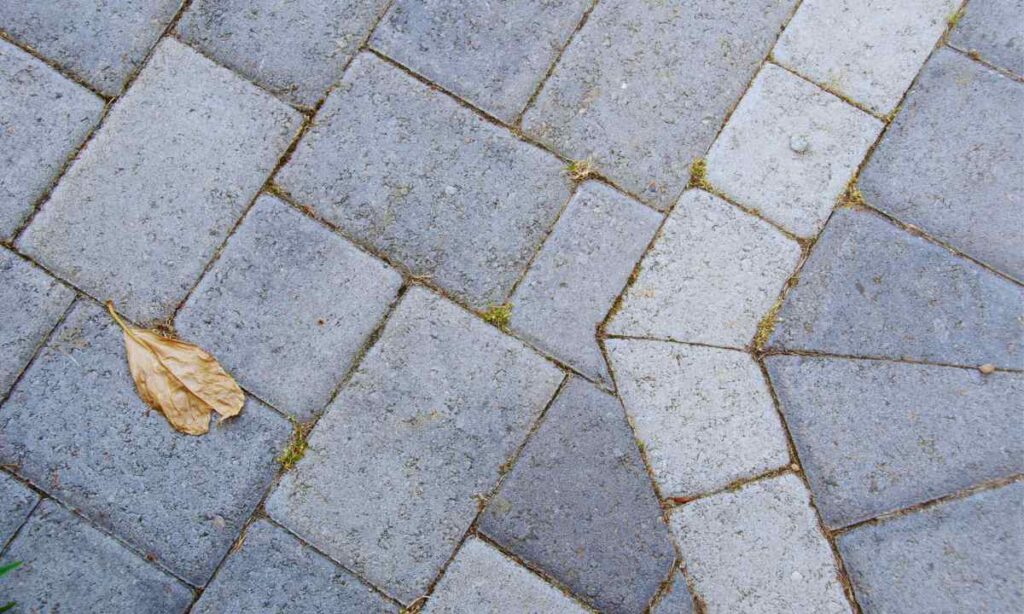
How Concrete Driveways Are Installed
Here’s how a standard concrete driveway gets built. First, the existing topsoil is removed. Then a subgrade is compacted usually crushed rock or gravel. This forms the base layer that supports the concrete.
Subgrade compaction is critical. If it’s uneven or poorly compacted, the slab above will settle or crack once water gets underneath it. That’s why driveways often fail early even if they looked fine when first poured.
After the forms are set, the concrete is poured and spread into place. Contractors add control joints to help guide where cracks will form as the slab naturally shrinks during curing. These joints don’t prevent cracks they just localize them.
Curing is the process of letting the concrete dry slowly and evenly. If it dries too fast, surface cracking and scaling are almost guaranteed. And once that process goes wrong, there’s no do-over.
Installation quality matters more than thickness alone. You could pour a 6-inch slab, but if the subgrade shifts or the joints weren’t cut right, it won’t last. At Retaining Wall & Paving Solutions, we’ve replaced plenty of thick concrete driveways that failed because the prep work didn’t match the site conditions especially in flood-prone or clay-heavy parts of St. Louis County.
Why Concrete Is Still Popular in St. Louis
Despite the issues, concrete is still the go-to for many homeowners and that’s mostly due to cost and familiarity.
-
Lower upfront cost: Concrete is often the cheapest option at install. Fewer labor hours, faster prep, and simpler materials make it budget-friendly in the short term.
-
Familiar appearance: Most people grew up with concrete driveways. It looks normal and blends into existing sidewalks, curbs, or garage thresholds without fuss.
-
Faster install timeline: With the right crew, a concrete driveway can be installed in a day and ready to use after a short curing period. That’s appealing when you’re on a tight schedule or selling the home soon.
But here’s the catch: concrete works fine when everything underneath it stays still which isn’t how St. Louis soil behaves. The freeze–thaw shifts, clay expansion, and water retention here aren’t kind to rigid slabs. That’s why more homeowners are starting to look at alternatives like permeable pavers not for trendiness, but for performance.
Drainage Performance: Which Driveway Handles Heavy Rain Better?
In St. Louis, heavy rain isn’t a once-in-a-while thing. Spring storms dump inches in hours, and backed-up gutters or poor grading can push that water straight toward your foundation. The way your driveway handles that runoff makes a huge difference not just in surface wear, but in what happens to the soil and structures around it.
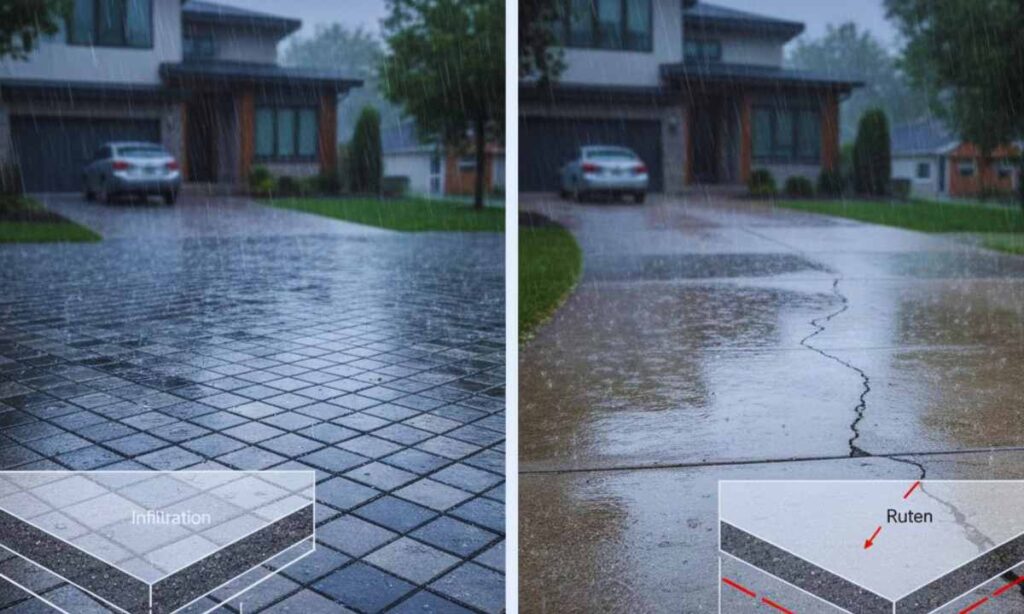
How Permeable Pavers Reduce Pooling and Runoff
Permeable pavers are designed to let water pass through the surface and into the ground below not slide off the top. That’s the core difference. Each paver is spaced slightly apart, with fine gravel or permeable sand in the joints. Rainwater doesn’t sit on the surface or flow across it. Instead, it seeps into the spaces, moves down into the open-graded base, and disperses slowly into the surrounding soil.
Surface infiltration like this reduces runoff dramatically. That means less water flowing toward your home’s foundation, garage slab, or low spots on the property. It also means fewer puddles sticking around long after the storm passes. Another key benefit is reduced ice formation. Because water doesn’t pool and freeze on top of the surface, you get fewer slippery patches in winter especially in shaded areas that stay cold longer.
If your home sits on a sloped lot, this difference is even more noticeable. Instead of rain racing down the driveway and collecting at the bottom, professionally installed permeable pavers system helps slow and manage the flow the entire way down. We’ve installed this type of system in hilly parts of Eureka and Des Peres where slope and runoff used to be a major headache. After switching to permeable pavers, the water stays put and the driveway stays dry.
Where Concrete Driveways Commonly Fail With Water
Concrete driveways are non-permeable, meaning they shed water by design. And that’s where the trouble starts.
During a storm, all the rain that hits the surface moves across the slab and down toward whatever’s lowest often your garage, yard, or the side of your house. If the driveway isn’t sloped perfectly or the soil around it can’t absorb the water fast enough, surface pooling is almost guaranteed.
This runoff doesn’t just disappear. It often soaks into the soil along your home’s perimeter, building up hydrostatic pressure that pushes against basement walls or slab foundations. Over time, that can lead to cracking, leaks, and erosion.
Concrete also holds onto water in small surface depressions. When temperatures drop, this trapped moisture freezes and expands which causes scaling, where thin surface layers begin to flake or chip away. We’ve seen this play out over and over in places like Brentwood and Ferguson especially where driveways slope toward the house or the yard already stays damp after rain. Even small grade errors in concrete can create long-term drainage headaches.
If you’re asking, Which driveway drains better in heavy rain? the answer is clear: Permeable pavers outperform concrete in both runoff control and long-term surface durability.
Winter Durability Comparison
St. Louis winters are a mess. One day it’s above freezing, the next it’s snowing, and by morning everything’s turned to solid ice. That back-and-forth is brutal on driveways especially when the surface isn’t built to handle constant movement underneath. If you’re trying to avoid surface cracks, edge blowouts, and scaling, it helps to know how each material holds up once the cold sets in.
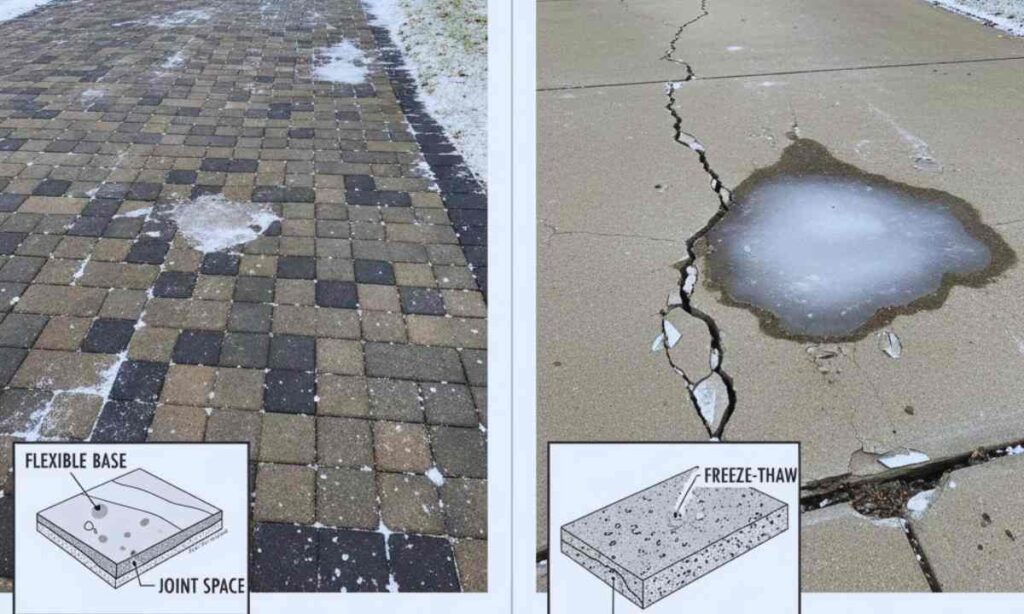
How Permeable Pavers Respond to Freeze–Thaw Cycles
Permeable pavers aren’t solid slabs they’re flexible systems. That’s the entire advantage in winter.
When the ground expands during a freeze, a concrete slab has nowhere to go. But pavers? Each one sits in a bed of open stone, with gaps between the units. That setup lets the surface shift a little without cracking. We’ve seen paver driveways come through nasty freeze–thaw swings in Affton and Ballwin with zero visible damage no surface pop, no mid-panel cracks.
Joint flexibility is the key. The spacing between pavers acts like a built-in buffer. When pressure builds, it spreads out. No stress point. No domino effect. And if a few pavers do settle wrong? No jackhammers. No slab saws. Just pull the affected bricks, adjust the base, and reset them. That’s one of the biggest advantages spot repairs are fast and clean, not a full-blown replacement project.
We’ve had clients call in late winter thinking they needed a full redo. Turned out, it was just four shifted pavers near the garage apron. We had it leveled and back in place within a day.
Why Concrete Cracks and Spalls in Missouri Winters
Now let’s talk about concrete and why it’s always the material we get called to fix after a cold snap. Concrete is rigid. It doesn’t flex, it fractures. When moisture gets under the slab and freezes, it expands. The pressure has nowhere to go but up or out, and that’s when the cracks start. First it’s a hairline near the joint. Then it creeps across the surface. Then it starts chipping.
This is what we call spalling when the top layer breaks apart from freeze-related stress. Throw in deicing salts, and it gets worse. Salt draws moisture into the surface. That moisture freezes, expands, and starts tearing the concrete up from the inside out. By February, you’ve got slabs that look ten years old. Corners pop. Cracks widen. You shovel once, and a chunk comes loose. Happens every year in spots like Chesterfield or North County, where shaded areas hold moisture longer.
We’ve replaced driveways where the concrete lasted less than five winters. The base was fine. The finish was smooth. But the material just couldn’t keep up with the freeze–thaw abuse Missouri throws at it. So here’s the bottom line: concrete can’t move and that’s why it breaks. Permeable pavers can move and that’s why they don’t.
Maintenance, Repairs, and Long-Term Flexibility
No driveway lasts forever without maintenance. But what really matters is how a surface holds up after the weather takes its toll and how much time, cost, or hassle it takes to keep things looking right. This is where the differences between permeable pavers and concrete become clear.
Maintaining a Permeable Paver Driveway
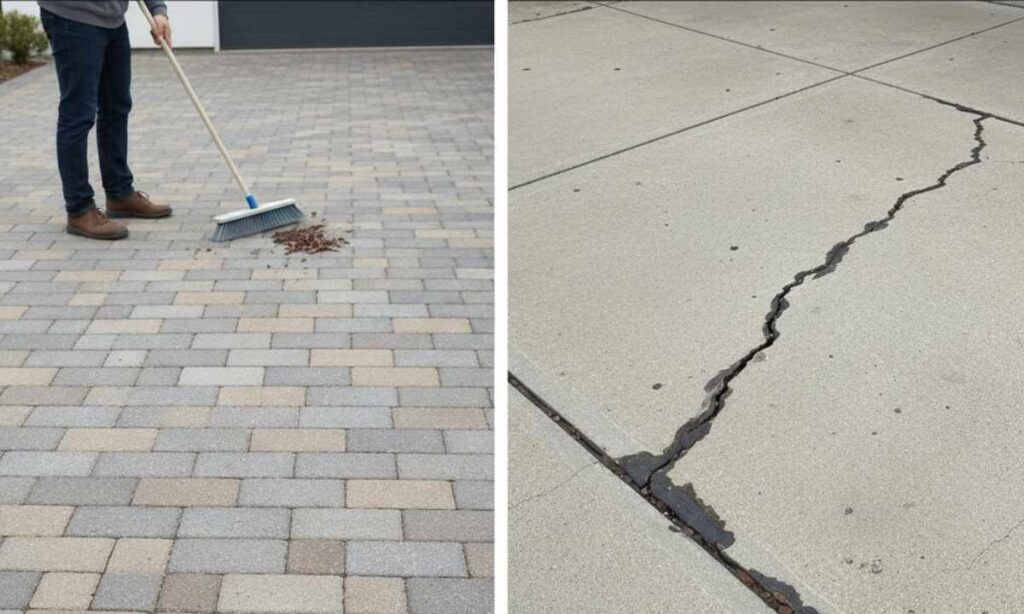
Permeable paver maintenance is more like upkeep than repair. Most of the work is light and preventive not reactive. Let’s start with the joint material. There are two main types: polymeric sand and permeable aggregate. Polymeric sand hardens slightly after wetting and helps lock pavers in place. It does a good job of resisting weed growth and washout, but in high-drainage areas or heavy rain zones, we often recommend permeable joint material instead. It lets water move more freely through the surface without clogging.
Weeds? That’s one of the biggest myths. You don’t get weeds because of the pavers you get weeds from wind-blown seeds landing in dirt that settles in the joints over time. A quick pass with a broom and occasional top-up of joint material keeps most of it in check. The real advantage is individual paver replacement. If one brick cracks or settles, you don’t need to tear up the whole driveway. You lift it out, reset the base if needed, and drop it back in. Compare that to concrete where one crack usually means you’re either living with it or patching something that never blends in.
Concrete Repairs and Their Limitations
Concrete repairs are always bigger than they seem at first. You can’t just fix a small spot and be done. Cracks tend to spread, and patches almost never match.
The go-to fix is usually crack sealing. But sealants stand out. They’re black, shiny, and textured and on a light-gray slab, the repair draws attention fast. If the crack is wide or growing, the only real fix is cutting and replacing that section of slab. That’s when the bigger problems start. Color mismatch is almost guaranteed. Even if the new concrete came from the same plant, curing conditions and batch differences will leave one part looking different than the rest.
We’ve had homeowners call after patching the same corner three years in a row. At that point, they’re spending more trying to save the slab than they would’ve spent replacing it properly the first time or switching to something easier to manage like pavers.
Side-by-Side Comparison for St. Louis Homes
Not sure which option makes more sense for your property? Let’s lay it out in plain terms. Here’s how permeable pavers stack up against concrete driveways when it comes to what actually matters in St. Louis rain, cold, soil movement, and long-term upkeep.
Permeable Pavers vs. Concrete Performance Breakdown
| Factor | Permeable Pavers | Concrete Driveway |
|---|---|---|
| Drainage | Water seeps through joints into a gravel base below; helps prevent pooling and runoff. | Water runs off the surface; prone to pooling or channeling toward your home. |
| Freeze–Thaw Resistance | Joint flexibility handles freeze cycles better; no slab to crack. | Rigid slab cracks under freeze–thaw stress; common in STL clay soils. |
| Repairability | Individual pavers can be lifted and replaced without visible patchwork. | Cracks require sealing or partial slab replacement; hard to match colour and finish. |
| Maintenance Demands | Occasional joint sand refresh and basic sweeping; no major tools needed. | Crack sealing, pressure washing, and eventual repouring required over time. |
| Expected Lifespan | 30+ years with routine upkeep; easy to refresh aesthetics. | 15–25 years depending on soil and drainage; replacements get expensive. |
Cost Reality for St. Louis Homeowners
It’s one thing to ask how much a driveway costs. It’s another to ask what that driveway actually costs you over time. Here’s the breakdown upfront, ongoing, and everything in between so you can make a smarter decision for your St. Louis property.
Installation Cost Differences (What Drives the Price)
- Labor intensity is the biggest reason why permeable paver driveways cost more upfront. Each paver has to be laid by hand, leveled, and compacted no shortcuts.
- Base preparation also runs deeper. A true permeable system uses a multi-layered, open-graded aggregate base that can be 12–18 inches deep. That takes more excavation, more gravel, and more time.
- Material costs vary. Pavers themselves are more expensive than a concrete pour, especially if you choose decorative or high-end finishes. Concrete is a single-pour slab with fewer moving parts.
- On average, expect permeable paver installs to cost 1.5× to 2× more than basic concrete up front.
But that’s just the start of the story.
Long-Term Cost of Ownership
- Repair frequency with concrete is the wild card. One crack can mean a full slab tear-out, especially in visible areas. And patch jobs rarely blend well.
- Paver driveways don’t work that way. You can replace a few bricks without touching the rest. No heavy machinery, no downtime, no mismatched finishes.
- Drainage-related damage is another hidden cost. Concrete that pushes runoff toward your foundation or garage can lead to much more expensive problems water intrusion, erosion, slab heave. Pavers let water drain down, not out.
Bottom line: If you’re planning to stay in your home long-term, pavers often pay off. Not just in fewer repairs, but in peace of mind especially when Missouri’s freeze-thaw cycles and rain events hit hard.
Appearance, Ride Feel, and Home Value
Curb appeal matters not just for resale, but for how your home feels every time you pull into the driveway. Let’s look at how each option stacks up when it comes to design, day-to-day use, and long-term perception.
Curb Appeal and Design Flexibility With Pavers
- Permeable pavers aren’t just functional they give you full creative control. You can choose different colors, patterns, textures, and edge borders that tie your whole landscape together.
- Want your driveway to match the patio or front walkway? No problem. You can create visual flow from the sidewalk to the front door and it doesn’t have to look like everyone else’s on the block.
- Pavers also maintain their finish better over time. They don’t stain as easily, and if one section fades or gets damaged, you can just replace that part no full redo needed.
- Visual flexibility is where pavers shine especially in higher-end St. Louis neighborhoods where design matters.
Concrete Appearance Over Time
- Here’s the thing with concrete: it looks great on day one. Clean, smooth, and simple. But give it a few seasons of Midwest weather, and things start to shift.
- Staining, leaf marks, and de-icing salt residue are common issues. Even sealed concrete eventually discolors. And cracks? They don’t just show they highlight wear, especially across large slabs.
- For resale, buyers notice these things. A worn concrete driveway can lower perceived value, especially if the rest of the home is well maintained.
- If your goal is long-term curb appeal and consistency, concrete requires more upkeep and still may not age as gracefully.
Environmental and Local Considerations
In St. Louis, what you build on your property doesn’t just affect your yard it can affect your neighbors, the street drainage, and even how your foundation holds up after a storm. That’s why choosing the right driveway material goes beyond looks or price.
Stormwater and Runoff Concerns in St. Louis Neighborhoods
Local flooding is a real issue, especially in older neighborhoods without updated stormwater infrastructure. When you have a solid-slab driveway like concrete water runs right off it. That runoff has to go somewhere, and too often, it ends up pooling near your foundation or overwhelming nearby drains.
Homes in areas like Webster Groves, Maplewood, and parts of South City see this first-hand especially after heavy spring and summer storms. And for properties with flat yards or poor slope, the problem gets worse. Pooling, erosion, and basement seepage often trace back to surface runoff and driveways play a major role.
When Permeable Driveways Make More Sense
Permeable pavers let water soak into the ground, not race across it. For sloped lots, this reduces the volume and velocity of runoff heading toward the street. On older properties with clay soil and tight drainage paths, permeable systems slow things down and spread the water underground not over your landscape. They’re also showing up more in HOA design guidelines and city drainage plans. Some municipalities in the St. Louis region like Clayton or Kirkwood have begun offering incentives or permitting fast-tracks for permeable options in areas with runoff issues.
If you’re in a neighborhood with known drainage concerns or if your lot sits lower than your neighbor’s permeable pavers may not be a trend; they might be a necessity.
Myths vs Reality About Permeable Pavers and Concrete
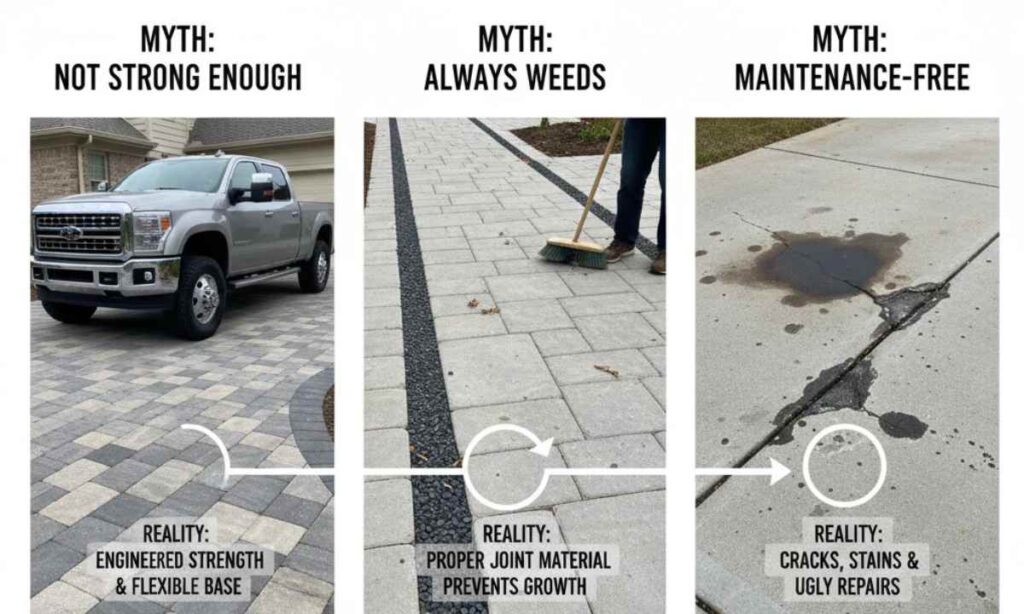
When it comes to driveways, a lot of homeowners in St. Louis hear the same half-truths from neighbors, Facebook groups, or outdated contractor advice. Let’s clear the air on three of the biggest misconceptions.
Permeable Pavers Aren’t Strong Enough for Cars
No, properly installed permeable pavers are absolutely strong enough for vehicles.
This one’s easy to debunk. The strength doesn’t come from the pavers alone it comes from the base. A correctly built permeable paver driveway has a deep, compacted aggregate foundation, often thicker than what concrete requires. That’s where the load-bearing capacity lives. We’ve installed permeable systems that support full-size trucks and trailers, no problem. The key is proper subgrade prep and edge restraint not just slapping down bricks on sand. When built right, permeable pavers outperform concrete in terms of freeze-thaw flexibility and long-term durability.
Weeds Always Grow Between Pavers
Not if the jointing material is done correctly. The truth is, weeds grow anywhere they get light, moisture, and organic debris including cracks in concrete slabs. With polymeric sand or permeable jointing aggregate, most weed growth is blocked before it starts.
What does cause weeds? Old paver jobs where the sand was never sealed or maintained, or when leaves and dirt build up in neglected joints. Think of it like grout on a tile floor it lasts if you install and maintain paver properly.
Concrete Is Maintenance-Free
Wrong, concrete might seem low maintenance at first, but it’s far from zero upkeep. Cracks will appear over time, especially with St. Louis freeze-thaw cycles. Deicing salts speed up surface spalling, and oil stains are tough to remove. Sealing is optional, but skipping it shortens lifespan. And repairs? They’re either cosmetic patches (that never match) or full slab replacements. Concrete hides its problems at first. But over the years, those issues become more visible and more expensive to fix.
Which Driveway Is Better for Your St. Louis Home?
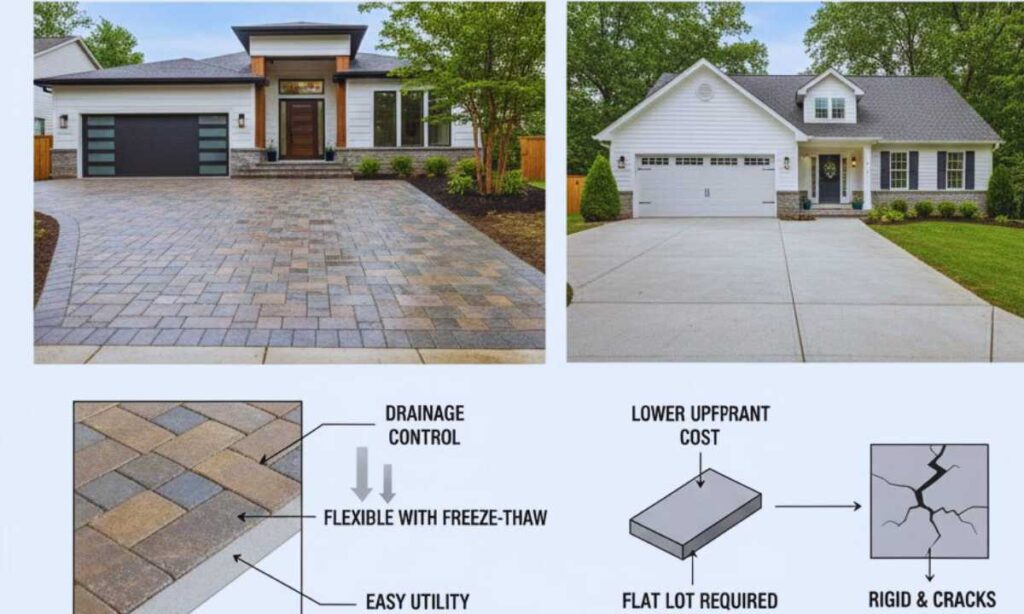
There’s no universal best when it comes to driveways just the best fit for your lot, budget, and goals. Here’s where each surface shines, depending on what your property is dealing with.
Permeable Pavers Are Better If…
-
You have drainage problems
If your current driveway pools after storms, slopes toward your house, or contributes to erosion, permeable pavers help absorb and redirect water right where it falls no French drains required. -
Freeze–thaw damage is a concern
Pavers flex with the seasons. Unlike concrete slabs, they don’t spall or crack in winter. That flexibility saves you stress and repair bills after each freeze cycle. -
You want long-term flexibility
Pavers can be pulled up and reset if something shifts or cracks underneath. They also make future upgrades easier like running utility lines or updating your landscape without demolition. -
For homes with challenging grades, older drainage setups, or future project plans, pavers offer durability with flexibility baked in.
Concrete May Make Sense If…
-
Your lot is flat and drains well
If water runs off cleanly and there’s no risk of pooling, concrete’s limited drainage ability isn’t a major downside. -
You’re focused on short-term costs
A basic concrete pour is cheaper upfront than permeable pavers, making it appealing for homeowners prioritizing immediate affordability over long-term savings. -
You’re not concerned with drainage or expansion
If your site has stable subsoil, minimal slope, and you’re not planning to modify the driveway later, concrete can be a solid, set-and-forget surface for a while. -
Concrete can be practical for simple lots where performance demands are low and upfront budget is the key driver.
Common Questions St. Louis Homeowners Ask
Stuck deciding between concrete and permeable pavers? These are the real-world questions we hear most from St. Louis homeowners weighing their options.
Do Permeable Pavers Freeze in Winter?
Yes, but they handle it better. Permeable pavers still experience freezing temps like any surface, but because they’re segmented and jointed, they flex with freeze–thaw cycles instead of cracking. Water drains through instead of pooling on top, which means less ice and fewer slippery spots.
Can Snow Shovels or Plows Damage Pavers?
No, if you use the right tools.
Rubber or plastic-edged shovels and snowblower skids are perfectly safe. For plowing, set the blade slightly above the surface just like you would on concrete and you’ll avoid chipping or shifting. Pavers can take snow and ice as long as you’re not scraping aggressively with metal blades. Bonus: Unlike concrete, if one paver gets chipped or stained by salt, you can replace just that one. No patchwork needed.
Which Driveway Lasts Longer in Missouri?
Pavers win for long-term durability. Concrete may give you 15–25 years, depending on drainage and winter exposure. But permeable pavers? They’re modular and repairable, which often stretches their usable life to 30 years or more especially if you keep the base well-prepped and joints maintained.
How Soon Can You Use Each Driveway After Installation?
Pavers are ready faster. Once the final compaction and sand setting are done, you can drive on a paver driveway the same day. Concrete needs 7 days minimum to cure 28 days for full strength. That delay can be a headache if you’re juggling contractors or trying to wrap up a project quickly.
Which Driveway Holds Up Better in Missouri Weather?
Missouri’s weather doesn’t play fair with driveways. Between the expansive clay soils, sudden downpours, and constant freeze–thaw cycles, surface damage isn’t a matter of if, but when. And for homeowners across St. Louis, this isn’t just a cosmetic issue it’s about function, safety, and long-term costs. Permeable pavers win when it comes to adaptability. Each paver acts independently, which means the system can flex as the soil shifts, handle water from major storms, and bounce back after winter freeze. More importantly, small issues stay small a cracked or sunken area doesn’t mean ripping out the whole driveway. Just replace the affected pavers and move on.
Concrete, on the other hand, is a rigid slab. Once moisture gets under it whether from poor grading or hairline cracks it starts breaking down. That’s when you’ll see spalling from deicing salts, cracks that widen over time, and repairs that never quite match. Worse, repairs don’t always last, and when the slab goes, it usually goes all at once.
Now, if you’ve got a flat lot, stable soil, and no drainage issues, concrete can still be a valid option. It’s quicker to install and typically cheaper upfront. But for most St. Louis homeowners, especially those in older neighborhoods or on sloped terrain, long-term performance outweighs initial savings.
Bottom line? If you want a driveway that actually works with Missouri’s climate not against it permeable pavers usually come out ahead. They’re not just built to last. They’re built to adjust. And that’s what matters in a place where the weather never stays still.