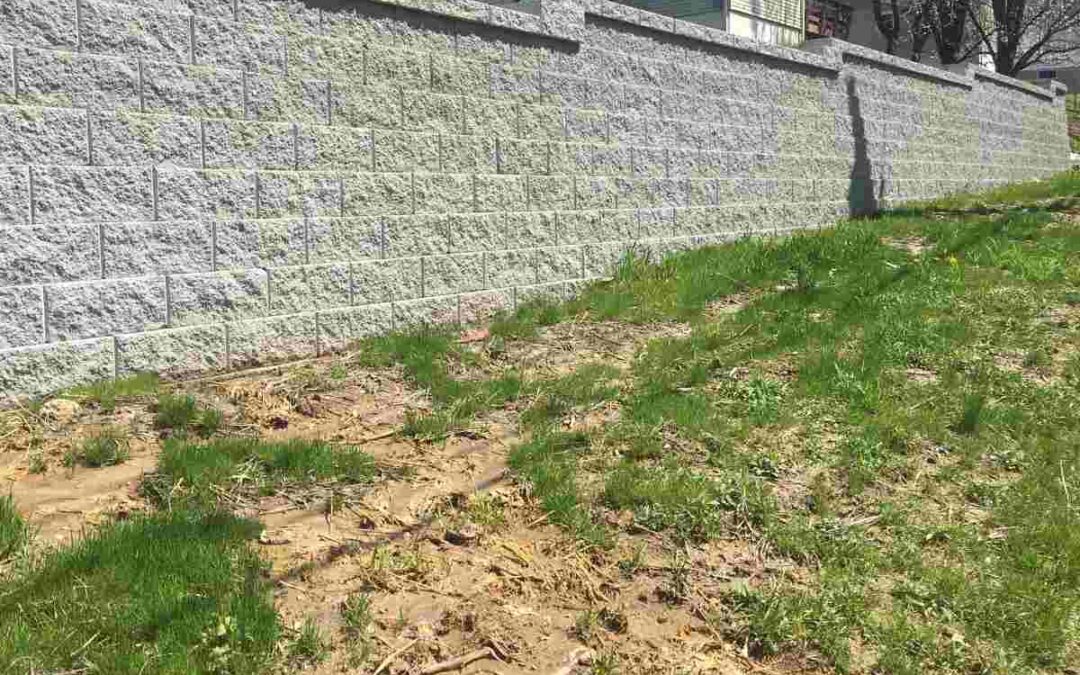
Retaining wall cost in the St. Louis metropolitan area covers everything a property owner pays before, during, and after construction: materials, labor, drainage systems, structural engineering, and the permits required to break ground. Installed pricing across the St. Louis metro typically ranges from $35 to $85 per square face foot, with most residential projects falling between $5,000 and $25,000. That range is wide for a reason. Wall height and soil conditions frequently drive cost in the same direction on the same project because a taller wall on expansive clay requires both deeper engineering and heavier drainage, compounding the scope instead of adding to it linearly.
The figures on this page reflect St. Louis-specific material pricing, labor markets, and regulatory costs rather than national averages built from homeowner-reported data across dozens of markets. This guide covers every variable that determines what a retaining wall costs in the St. Louis metro, starting with the site conditions and engineering thresholds that set the project scope before a single block is laid.
What Is the Average Cost of a Retaining Wall in St. Louis?
A retaining wall in the St. Louis metropolitan area typically costs $35 to $85 per square face foot installed, with most residential projects ranging from $5,000 to $25,000 depending on wall height, material selection, and site conditions. Commercial and engineered walls exceeding 6 feet commonly exceed $40,000. These figures reflect installed cost: materials, labor, base preparation, and standard drainage combined into a single square-foot price.
Residential projects under 4 feet in height, spanning 20 to 60 linear feet, typically fall in the $5,000 to $15,000 range. Walls at this height function as gravity structures with minimal reinforcement. Base preparation, compacted aggregate, drainage stone that routes water away from the wall face, and cap units are included in these ranges.
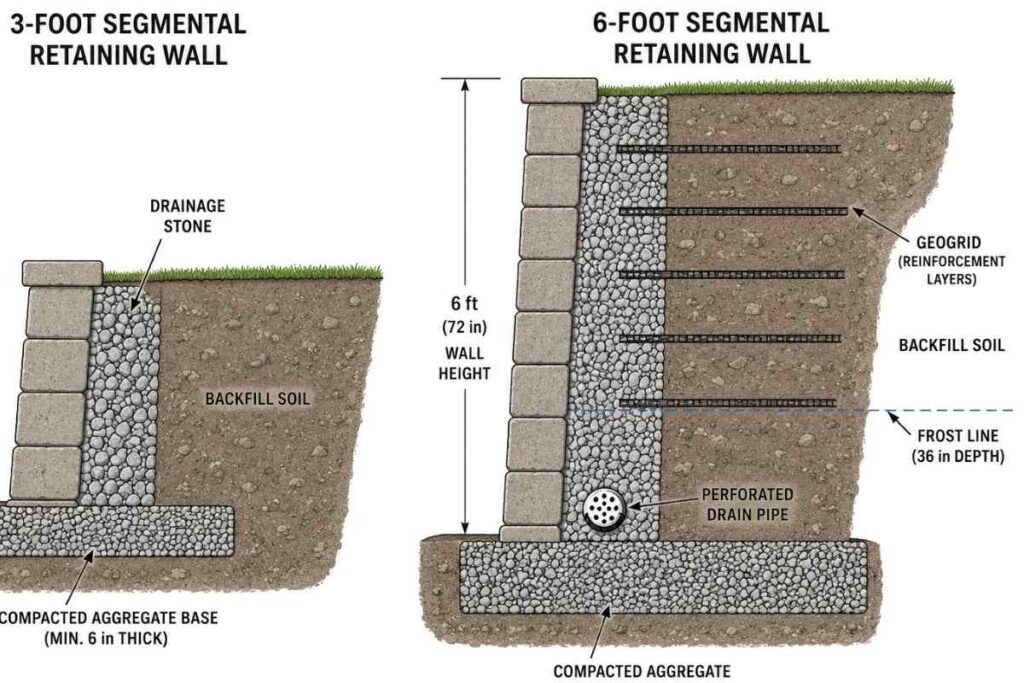
The cost structure shifts at 4 feet. Most Missouri jurisdictions require engineered design at that height threshold, which adds geogrid reinforcement layers, deeper leveling pad excavation, and increased drainage capacity behind the wall. Residential projects between 4 and 6 feet typically range $15,000 to $25,000, excluding engineering fees, permit costs, and geotechnical reports, which are broken out later in this guide.
Commercial and large-scale projects commonly range $25,000 to $75,000 or more. Three conditions push projects into this tier: wall height exceeding 6 feet, tiered construction where two or more walls step up a slope, and surcharge loads from driveways, structures, or heavy equipment positioned above the wall. Any one of those conditions increases structural requirements. When two or three overlap on the same site, engineering scope compounds.
The regulatory layer hits differently on commercial projects. Engineered drawings require a Missouri PE stamp. St. Louis County grading permits apply when projects disturb more than 5,000 square feet or move more than 100 cubic yards of soil, and soil reports are standard on commercial sites because the region’s expansive clay shrinks and swells with seasonal moisture changes, creating variable lateral pressure that cannot be designed against without site-specific soil classification data.
Retaining wall cost is measured per square face foot, not per linear foot. The difference is structural. Square face foot captures both dimensions of the wall by multiplying height by linear footage, which means a 3-foot wall at 50 linear feet produces 150 square face feet while a 6-foot wall at the same length produces 300. The material volume, geogrid reinforcement schedule per the NCMA Design Manual for Segmental Retaining Walls, excavation depth, and labor hours between those two walls are not comparable, even though the linear footage is identical. Height changes everything.
That distinction matters when evaluating quotes. A bid stating “$50 per linear foot” communicates nothing about structural scope without a height specification, because the requirements at 3 feet and 6 feet share almost nothing in common. Square face foot pricing accounts for both dimensions and reflects what the wall actually requires to build.
What Factors Drive Retaining Wall Cost?
Retaining wall cost is driven by seven primary variables: wall height, linear footage, material type, site access and slope grade, soil conditions, drainage requirements, and engineering and permit scope. Height is the single largest cost driver because structural, material, and labor requirements do not scale proportionally with each additional foot of wall. They compound.
Walls under 4 feet function as gravity structures. The weight of the block and backfill alone resists lateral earth pressure, and most projects at this height require no engineered design, no geogrid, and no PE-stamped drawings. Above 4 feet, the structural demands change in kind, not just degree. Geogrid reinforcement layers are required at specified vertical intervals, the leveling pad must be excavated deeper to achieve adequate embedment, and drainage capacity behind the wall increases to handle the greater volume of retained soil.
Cost per square face foot between a 3-foot wall and a 6-foot wall reflects these compounding requirements, not just additional courses of block. The specific dollar ranges by height tier are covered in the cost-by-height section of this guide.
The St. Louis metropolitan area sits on expansive clay soils classified as CL and CH under the Unified Soil Classification System. These classifications describe fine-grained soils with moderate to high plasticity that change volume with moisture content. When wet, they swell and push laterally against the wall. When dry, they shrink and pull away, leaving voids that collect water during the next rain cycle.
That wet-dry cycle is the problem. The lateral pressure against a retaining wall on CL/CH soil is not constant. It fluctuates seasonally, which means the wall must be designed for the peak load, not the average. Projects on expansive clay typically require a geotechnical report to classify the soil and determine the design parameters, and the base excavation is often deeper than what non-expansive sites require.
Expansive clay compounds drainage requirements because the soil itself does not drain. Water that enters the backfill zone behind the wall has no natural path through the surrounding clay, so it accumulates. Increased drainage aggregate volume behind the wall and stronger geogrid reinforcement schedules are standard on CL/CH sites to compensate. When drainage is undersized or blocked on an expansive clay site, hydrostatic pressure builds behind the wall face. That is lateral water pressure with nowhere to go. It is the most common structural cause of retaining wall failure in moisture-reactive soil regions.
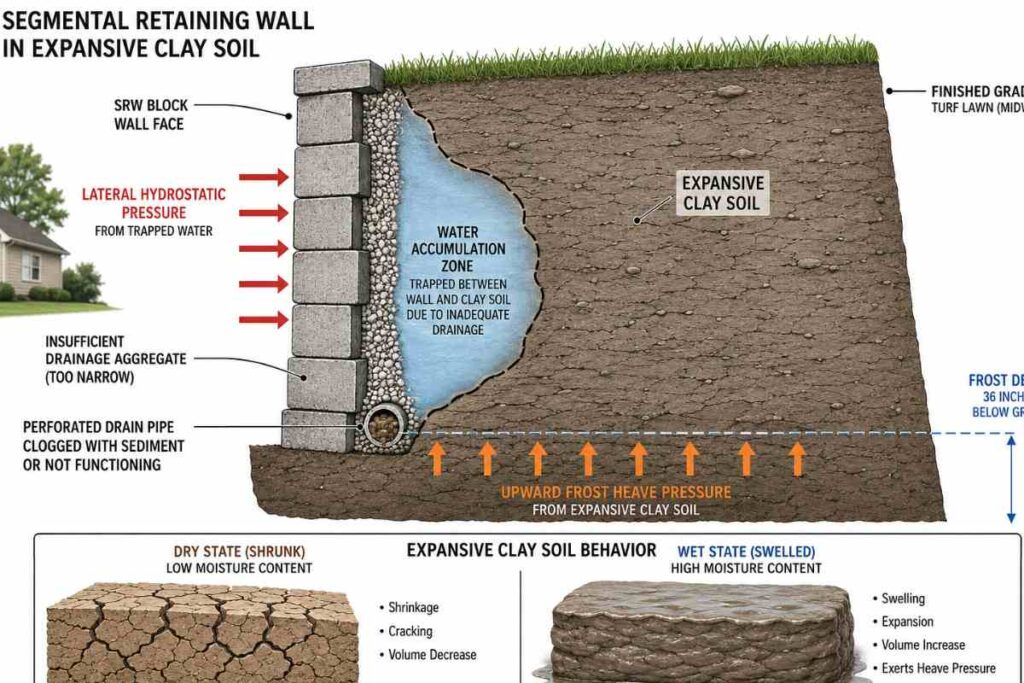
Frost heave adds a second displacement force on the same walls. At 36 inches, the St. Louis frost depth per IRC Table R301.2(1) means ice lenses can form in moisture-saturated soil at significant depth during winter freeze cycles, exerting upward pressure on wall structures from below. Walls on expansive clay with inadequate drainage face both forces simultaneously: hydrostatic pressure pushing laterally and frost heave pushing upward.
Both failures start below grade. The leveling pad and drainage outlet placement must account for that 36-inch frost line. A leveling pad set above the frost depth is vulnerable to seasonal heave that lifts and displaces wall courses from the base up. Drainage outlets set too shallow freeze closed during the months when water management matters most. Both are design decisions made before construction, and both carry cost because they require deeper excavation and longer outlet runs.
A retaining wall supporting a driveway, patio, or structure above it bears surcharge loads that change the engineering equation. Surcharge loads require deeper embedment below grade, closer geogrid spacing in the reinforced zone, and in some cases thicker wall units to handle the additional lateral and vertical forces. Miscalculating surcharge loads is one of the most common causes of retaining wall failure because the wall may appear structurally sound under its own soil load but was never designed to carry the weight above it.
The engineering cost to account for surcharge loads properly adds $1,000 to $3,000 or more to a project. This is a surcharge-specific design fee, separate from the base PE stamp cost and the height-threshold engineering cost, both of which are broken out in later sections of this guide.
Restricted site access increases labor cost 15% to 30% on retaining wall projects. Narrow side yards, steep hillside lots along the Meramec River corridor, and elevated properties along the I-44 and I-270 hillside developments are common in the St. Louis metro. These sites limit or eliminate equipment access for excavators, skid steers, and material delivery trucks.
A project requiring hand-carried block, aggregate, and drainage stone to a backyard site with no equipment path will cost measurably more per square face foot than an identical wall specification on an open lot with full truck and excavator staging. The wall design does not change. The labor hours do.
How Much Do Different Retaining Wall Materials Cost?
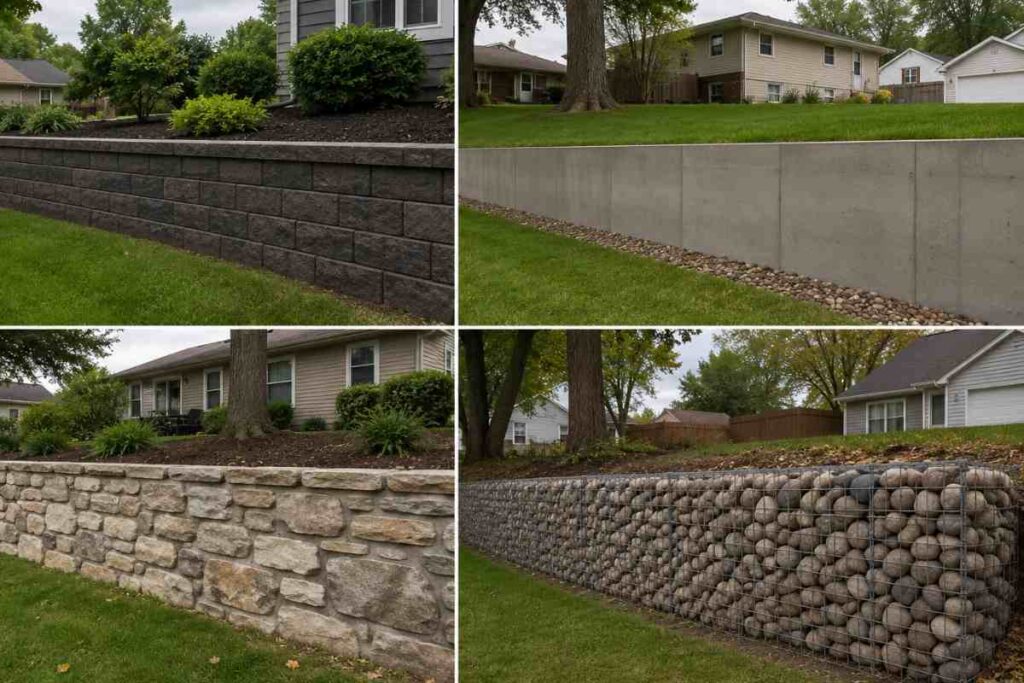
Segmental retaining wall block is the most common material for residential and commercial walls in St. Louis at $30 to $55 per square face foot installed. Poured concrete runs $45 to $75, natural stone $50 to $85, and timber $20 to $35, but material cost alone does not determine which system performs over time. Lifespan, structural capability, and repairability separate these materials more than price does.
| Material | Cost/Sq Face Ft (Installed) | Expected Lifespan | Best For |
|---|---|---|---|
| SRW Block (per ASTM C1372) | $30 – $55 | 50+ years | Residential and commercial walls of any height; engineered walls with geogrid reinforcement |
| Poured Concrete | $45 – $75 | 50+ years | Monolithic structural walls; commercial applications requiring continuous footings |
| Natural Stone (limestone, fieldstone) | $50 – $85 | 50+ years with maintenance | Aesthetic-priority projects where skilled masonry is available and budget allows |
| Gabion Baskets | $25 – $50 | 25 – 50 years (wire cage dependent) | Low-height walls on shifting soils; drainage-critical sites where water must pass through the wall face |
| Timber (pressure-treated) | $20 – $35 | 10 – 15 years | Temporary or decorative walls under 4 feet with no surcharge loads |
Segmental retaining wall units conforming to ASTM C1372 dominate the St. Louis market for a structural reason. SRW block is the only wall material with a dedicated engineering standard written specifically for retaining wall design. The NCMA Design Manual governs how SRW walls are engineered, specifying geogrid reinforcement schedules, embedment depth, and drainage requirements by wall height. No other material type has an equivalent design standard purpose-built for retaining wall systems.
That engineering compatibility matters at scale. SRW systems are designed to work with geogrid reinforcement, which means they can be engineered for heights well above the 4-foot gravity threshold. The material holds up over time. The 50-plus year expected lifespan reflects high compressive strength, low absorption, and dimensional consistency across manufactured units. If a section of wall is damaged decades after installation, individual units can be removed and replaced without demolishing the structure. No poured concrete or natural stone wall offers that modular repairability.
Every SRW unit must meet physical requirements under ASTM C1372 before it leaves the manufacturing facility: compressive strength minimums, moisture absorption limits, and dimensional tolerances that keep each block’s physical properties within tested limits. The specification exists because retaining walls are load-bearing structures, and the block is the element that resists earth pressure across the wall face. Blocks that pass carry a measurable performance baseline.
Manufacturer structural warranties on SRW block typically cover 75 years on the unit itself. That warranty covers the physical block. It does not cover the installation, the drainage, or the geogrid. The distinction matters. A wall built with warranted block but inadequate drainage will still fail from hydrostatic pressure regardless of the block’s compressive strength. The warranty reflects material durability. Performance depends on the system.
Poured concrete walls require formwork, rebar placement, and cure time, which makes them the most labor-intensive wall type. Installed cost runs $45 to $75 per square face foot. The result is a monolithic structure with no joints, which eliminates the modular repairability of SRW but provides a continuous structural surface suited to commercial applications requiring specific load-bearing configurations. Natural stone walls run $50 to $85 per square face foot and carry the highest material and labor costs because each stone must be individually selected, shaped, and placed by a skilled mason, and natural stone cannot be reinforced with geogrid, which limits engineered height without independent structural support.
Gabion baskets ($25 to $50 per square face foot installed) use wire cages filled with stone or recycled concrete. They are flexible on shifting soils and allow water to pass directly through the wall face, which eliminates the need for a separate drainage system behind the wall. That permeability is their primary structural advantage. Gabion walls cannot be engineered with geogrid reinforcement and are limited to heights of 4 to 6 feet, which restricts them to low-height, drainage-critical applications where their water-passing capability outweighs their height limitation.
Pressure-treated timber walls at $20 to $35 per square face foot installed carry the lowest upfront material cost. The tradeoff is lifespan. Timber walls last 10 to 15 years before structural degradation from moisture absorption, insect damage, and sustained soil contact breaks down the wood fiber. A timber wall that costs $8,000 today will need full replacement within that window.
Timber cannot be reinforced with geogrid, cannot support surcharge loads from driveways or structures above it, and cannot be engineered to meet Missouri building code requirements for walls over 4 feet. The replacement cost of a timber wall within its lifespan typically exceeds the initial cost of an SRW or concrete wall built once to a 50-year standard. Low upfront cost and low total cost are not the same measurement.
What Does a Retaining Wall Cost by Height?
A 2-foot retaining wall in St. Louis typically costs $25 to $40 per square face foot. A 4-foot wall runs $35 to $55. A 6-foot engineered wall costs $50 to $75, and walls at 7 to 8 feet or taller reach $65 to $85 or more per square face foot. These ranges do not increase at a flat rate because every additional foot of height adds structural requirements that compound rather than stack.
Height determines cost more than any other variable because it changes what the wall requires to stand. Each tier below reflects installed cost per square face foot including materials, labor, base preparation, and standard drainage:
- 2 feet: $25 to $40 per square face foot. Gravity wall design. No engineering, no geogrid, no permit in most jurisdictions.
- 3 to 4 feet: $35 to $55 per square face foot. Drainage becomes critical. Projects at 4 feet approach the engineering threshold where most Missouri jurisdictions require PE-stamped design.
- 5 to 6 feet: $50 to $75 per square face foot. Engineered design required. Geogrid reinforcement layers at specified intervals, deeper leveling pad, and increased drainage aggregate volume behind the wall.
- 7 to 8+ feet: $65 to $85 or more per square face foot. Multiple geogrid layers, deep embedment, and heavy drainage infrastructure. Single-wall construction may give way to tiered wall design where two or more shorter walls step up the slope.
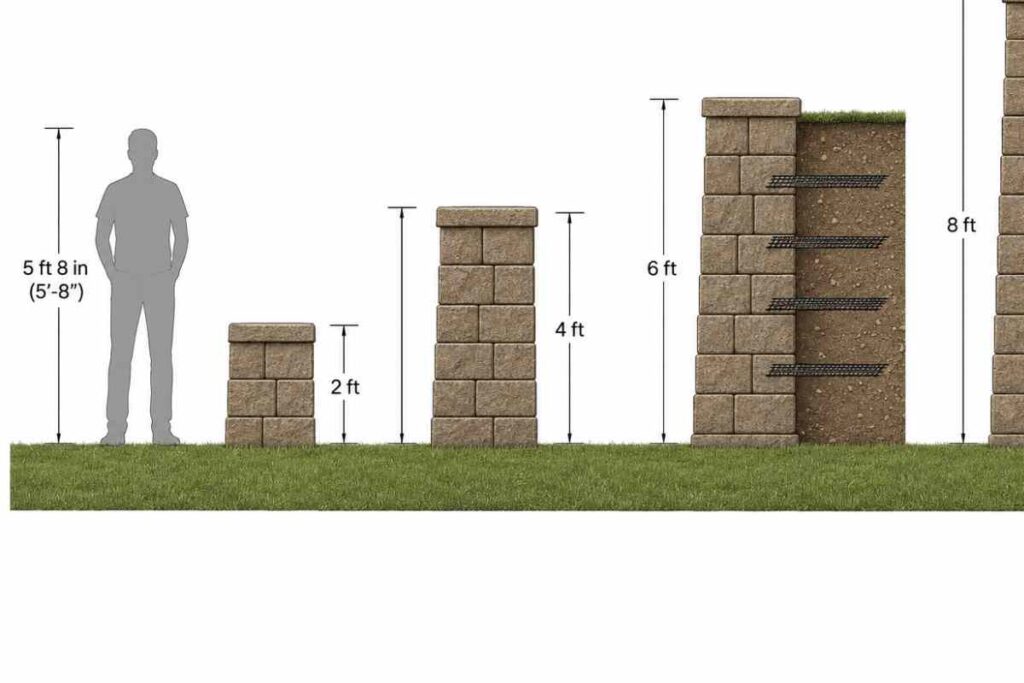
The math is not linear. A 6-foot wall requires engineered drawings, geogrid reinforcement at multiple depths, a deeper leveling pad, and drainage capacity sized for the full retained soil volume. Each addition carries its own material, labor, and professional service cost. A 6-foot wall typically costs three to four times what a 3-foot wall costs on the same site, not twice.
Most Missouri jurisdictions require engineered retaining wall design for walls exceeding 4 feet of exposed height, consistent with IRC Section R404 requirements for foundation and retaining structures. That threshold is not a gradual cost increase. It is a step function. A 3-foot-11-inch wall and a 4-foot-1-inch wall may use identical block and similar labor hours, but the taller wall triggers $3,000 to $8,000 or more in professional engineering and permitting costs that the shorter wall does not carry.
This is the height-triggered engineering cost. It is separate from surcharge-specific engineering fees, which apply when driveways, structures, or equipment loads sit above the wall regardless of height. It is also separate from the base PE stamp drawing cost, which covers the professional service of producing and stamping construction documents. The permit process and specific PE stamp requirements for St. Louis County and City of St. Louis jurisdictions are covered later in this guide.
What Hidden Costs Do Retaining Wall Quotes Miss?
The most common exclusions in retaining wall quotes are engineering fees, permit costs, geotechnical reports, demolition of existing walls, finish grading and landscape restoration, and drainage systems. These exclusions can add $4,000 to $15,000 to a project that was quoted at materials and labor only.
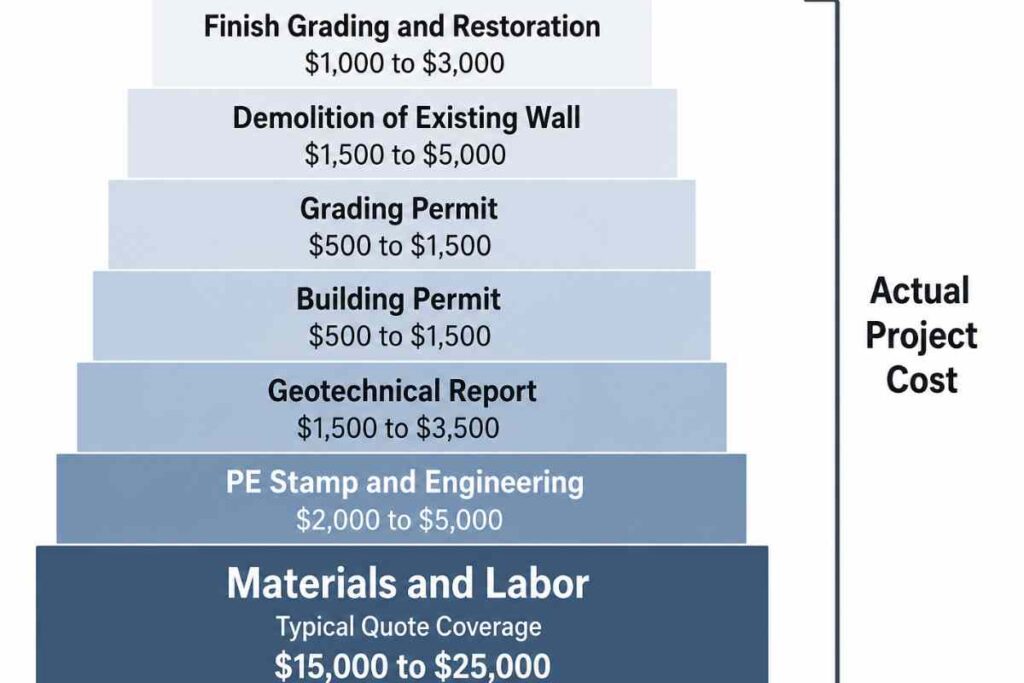
Structural engineering drawings with a Missouri PE stamp typically cost $2,000 to $5,000 as a base professional service fee. This is the cost of producing and stamping construction documents. It is separate from the height-triggered engineering that applies when a wall exceeds 4 feet, and separate from the surcharge-specific design work required when loads sit above the wall. A homeowner reviewing quotes often sees “engineering” as a single line item, but it can represent two or three distinct charges depending on wall height and site conditions.
Geotechnical investigation for soil classification runs $1,500 to $3,500. On expansive clay sites common across the St. Louis metro, the soil report determines the design parameters for reinforcement and drainage. St. Louis County grading permits apply when a project disturbs more than 5,000 square feet or moves more than 100 cubic yards of soil, adding $500 to $1,500 in permit fees. All three costs exist outside the materials-and-labor quote, and all three are required by code for engineered walls.
Residential retaining wall construction typically takes 3 to 10 days on site depending on wall size and access conditions. That timeline covers only the build. Engineering review and permit approval add 2 to 4 weeks before the crew arrives, which means the total project timeline from signed contract to completed wall runs 4 to 8 weeks for engineered projects.
Most quotes communicate the construction window. Few communicate the full timeline. A homeowner who signs a contract expecting a wall in two weeks will wait four to eight weeks on an engineered project, and that expectation gap creates frustration that has nothing to do with construction quality.
Removing a failed existing retaining wall adds $1,500 to $5,000 or more to the project. That cost varies by material. Concrete demolition costs more than timber removal because concrete requires mechanical breaking and heavier haul-off loads. The disposal cost depends on wall size, material weight, and distance to the nearest disposal facility.
Finish grading behind and in front of the new wall, topsoil replacement, and landscape restoration for sod, seed, or plantings disturbed during construction are frequently excluded from base quotes. Site preparation and restoration typically add $1,000 to $3,000. The work is not optional because the area surrounding a retaining wall installation is excavated, compacted, and stripped during construction, and it does not return to a usable condition without grading and restoration.
A retaining wall without proper drainage behind it will fail from hydrostatic pressure regardless of how well the wall itself is built. That failure mode was covered earlier in this guide. The drainage system is not an add-on. It is a structural component.
Drainage systems for retaining walls include perforated pipe at the base of the wall, drainage aggregate backfill behind the wall face, filter fabric separating the aggregate from the native soil, and a daylight outlet or tie-in to the storm system. These components represent 10% to 15% of total project cost, and any quote that excludes drainage or lists it as optional is pricing an incomplete wall system that carries a structural liability from the day it is built.
Does a Retaining Wall Need a Permit in St. Louis?
In St. Louis County, retaining walls over 4 feet in exposed height require a building permit and engineered drawings bearing a Missouri PE stamp. Grading permits apply separately when projects disturb more than 5,000 square feet or move more than 100 cubic yards of material. The City of St. Louis administers its own permit requirements through the Building Division, with separate application processes and fee structures from the County.
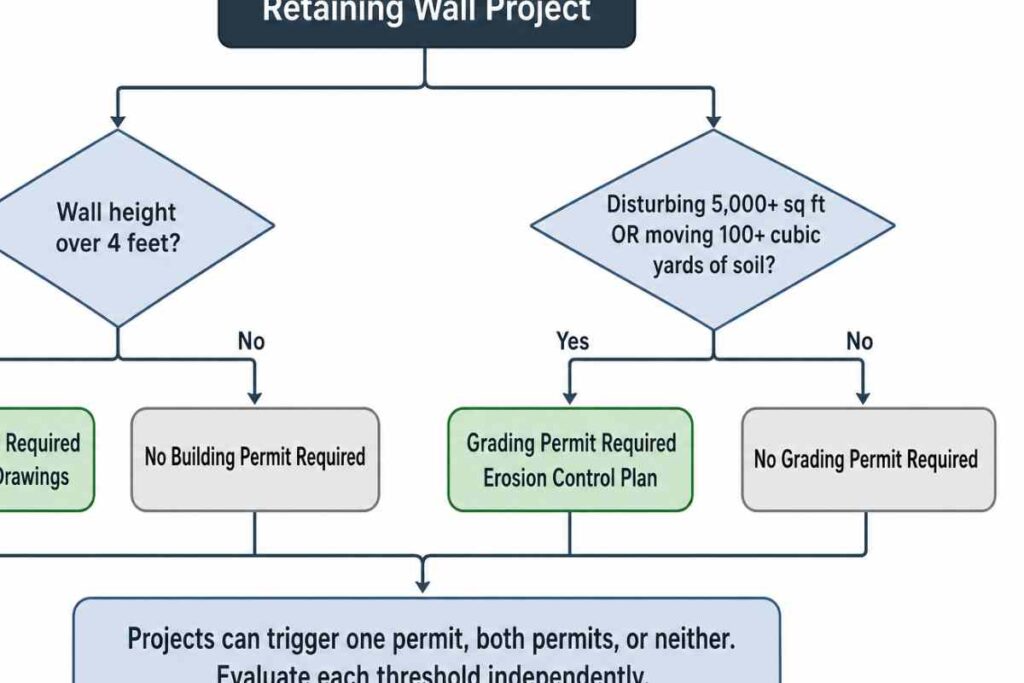
Permits for retaining walls in the St. Louis metro are triggered by two independent thresholds. Both can apply to the same project:
- Building permit: Walls exceeding 4 feet of exposed height require PE-stamped engineered drawings submitted through the St. Louis County Department of Planning. Drawings must show wall design, geogrid reinforcement layout, drainage specifications, and embedment depth, and the County reviews them against IRC §R404 before issuing permits.
- Grading permit: Projects moving more than 100 cubic yards of soil or disturbing more than 5,000 square feet of land require a separate grading permit with an erosion control plan. This applies even if the wall is under 4 feet and exempt from a building permit.
- Timeline and fees: Retaining wall Permit review typically takes 2 to 4 weeks and adds $500 to $1,500 depending on the scope of disturbance. That window runs before construction starts, not alongside it.
No drawing package, no permit. The two triggers operate independently, which catches homeowners off guard. A project with a 3-foot wall that moves 150 cubic yards of soil during grading does not need a building permit but does need a grading permit. A homeowner told “your wall is under 4 feet, no permit needed” may still owe one based on site disturbance alone.
An unpermitted retaining wall that required a permit creates problems that follow the property, not the contractor. These are not construction-phase risks but ownership liabilities that persist through every transfer. Three consequences surface:
- Liability: The property owner carries full liability for any failure, settlement, or property damage because no jurisdictional inspection verified the design or construction met code.
- Retroactive cost: The wall may need to be removed or re-engineered to obtain a retroactive permit. That process costs more than the original because it requires an as-built engineering assessment on top of the standard review.
- Sale impact: The unpermitted structure surfaces during home inspections, where it delays closings, reduces appraised value, or kills transactions when buyers or lenders refuse to accept the liability.
A contractor who does not discuss permit requirements before presenting a quote has either not evaluated the project scope or is pricing work they intend to perform without permits. Either signals a problem. The permit conversation should happen at the first site visit, not after the contract is signed. By that point, permit scope and timeline should already be part of the documented quote.
Does a Retaining Wall Increase Property Value?
A retaining wall that solves a functional problem typically recovers 50% to 60% of its cost in property value at resale, based on national hardscape ROI data from the National Association of Landscape Professionals. Purely decorative retaining walls without a structural purpose recover less because the value is tied to what the wall does for the property, not what it looks like.
A retaining wall that stops active erosion, protects a foundation from slope pressure, or prevents stormwater damage to a structure is not a discretionary improvement. It is damage prevention. The cost of not building it includes ongoing soil loss, potential foundation damage that can run $10,000 to $50,000 or more to remediate depending on severity and structural involvement, and progressive property value decline as the visible damage worsens with each weather cycle.
The retaining wall cost in these situations is measured against the cost of the problem it prevents, not against a zero baseline. A $15,000 retaining wall that stops a foundation erosion pattern carrying $30,000 or more in potential remediation cost is not an expense. It is the less expensive outcome. That framing changes the ROI calculation from “what do I get back at resale” to “what do I lose if I do nothing.”
A retaining wall that converts an unusable slope into a level yard, patio area, or buildable pad creates measurable square footage of usable outdoor space. In the St. Louis metro market, according to National Association of Realtors data on outdoor living features, usable outdoor space adds tangible resale value when the space is genuinely functional and the construction is sound. The value is tied to the amount of usable area created and the quality of construction, not to the wall structure itself.
Appraisers evaluate what the wall enables, not what it cost. A retaining wall that creates 800 square feet of level yard on a previously unusable slope adds value as usable lot area. A retaining wall that holds back a grade change but creates no functional space adds structural stability without measurable square footage.
A failing or poorly built wall reverses the value equation entirely. Home inspectors flag leaning walls, visible displacement, drainage failures, and unpermitted structures, and those findings reduce appraised value or stall transactions. The wall becomes a liability, not an asset.
How to Compare Retaining Wall Quotes in St. Louis
Compare retaining wall quotes by verifying five scope elements: wall system specification, engineering inclusion, permit responsibility, site prep and restoration scope, and warranty terms covering both materials and labor. The lowest quote is frequently the most expensive project when excluded scope surfaces mid-construction. Every missing element is a cost the homeowner will pay later, either as a change order or as a failure.
A complete retaining wall quote defines the wall system and assigns responsibility for every professional service the project requires. These five elements must be present and specific:
- Wall material specification: Material type, unit size, color, and manufacturer named. A quote that says “retaining wall block” without identifying the product is not comparable to one that names the manufacturer and unit.
- Geogrid reinforcement schedule: Geogrid type, spacing, and length per reinforcement layer. Omitting this from a quote for a wall over 4 feet means the structural reinforcement is unspecified.
- Drainage system components: Pipe diameter, aggregate type and depth, filter fabric, and outlet location. A quote that excludes drainage is pricing an incomplete wall.
- Engineering and PE stamp responsibility: Whether engineered drawings are included or excluded and who bears the cost. This is the most commonly excluded professional service item in retaining wall quotes.
- Permit acquisition responsibility: Whether permit fees and the application process are included or excluded and who manages the submittal.
A quote missing any of these five elements is structurally incomplete. It cannot be compared to a complete quote because the two bids are pricing different walls. The comparison only works when both quotes define the same scope, the same materials, and the same professional service responsibilities. Those gaps add up. Engineering and permit exclusions alone can add $4,000 to $8,000 to a project that appeared lower on paper.
Underbidding starts with scope exclusion. Engineering, permits, drainage, geotechnical investigation, finish grading, and landscape restoration are stripped from the base price. The homeowner sees a lower number, signs the contract, and encounters change orders or scope gaps after construction begins.
A second pattern is material substitution. Smaller block units, thinner drainage aggregate, or lower-grade geogrid reduce material cost on the quote but compromise structural performance and wall lifespan. The homeowner does not see the substitution because the quote says “retaining wall block” without naming the manufacturer, unit size, or specification standard. The difference shows up years later when the wall underperforms.
Verify Missouri contractor licensing and confirm that general liability and workers compensation insurance certificates are current and name the contractor performing the work. Licensing in Missouri is administered at the municipality level, not statewide, so verify active registration with the jurisdiction where the project will be built. Ask for certificates, not verbal confirmation. Installers holding NCMA SRW certification have completed training specific to segmental retaining wall engineering and installation standards, and that credential is a competence signal, not a legal requirement.
Request the name of the structural engineer who will stamp the drawings before signing a contract. Confirm the engineer holds an active license with the Missouri Board for Architects, Professional Engineers, Professional Land Surveyors, and Professional Landscape Architects. A contractor who cannot name their engineer before quoting has not secured engineering services for the project.
Ask why. That means the engineering scope, timeline, and cost are undetermined at the time of the quote, which makes the quote unreliable for an engineered wall project. The engineer should be part of the project team before the homeowner is asked to commit.
When Should You Invest in a Retaining Wall vs Other Solutions?
A retaining wall is the correct solution when the slope exceeds a 3:1 grade, when usable space must be created at a grade change, or when structural loads sit above or below the slope. Regrading, slope stabilization plantings, and French drain systems cost less but only solve the problem when the grade is moderate, no structural load exists, and no usable space needs to be created. The right answer depends on what the site requires, not on which option costs the least.
The table below compares the four most common approaches to slope and drainage problems on residential properties in the St. Louis metro.
| Solution | Cost Range | Best When | Limitations |
|---|---|---|---|
| Retaining wall | $35 – $85/sq face ft installed | Slope exceeds 3:1 grade; usable space needed at grade change; surcharge loads present above or below slope | Highest upfront cost; requires engineering above 4 ft; permit and drainage requirements add professional service costs |
| Regrading | $3 – $8/sq ft | Moderate slopes (4:1 or gentler) with available space to redistribute soil without encroaching on structures or property lines | Cannot create usable level space on steep grades; does not address surcharge loads; may require grading permit on larger sites |
| Slope stabilization plantings | $2 – $6/sq ft | Gentle to moderate slopes with no structural loads; erosion control on grades where soil movement is surface-level | Cannot hold structural loads; requires ongoing maintenance (plant replacement, irrigation); 2 to 5 year establishment period before full effectiveness |
| French drain system | $25 – $50/linear ft | Subsurface water management on sites where drainage is the primary problem; complements other solutions but does not retain soil | Does not retain earth or create usable space; requires periodic cleaning; does not address slope grade or structural loads |
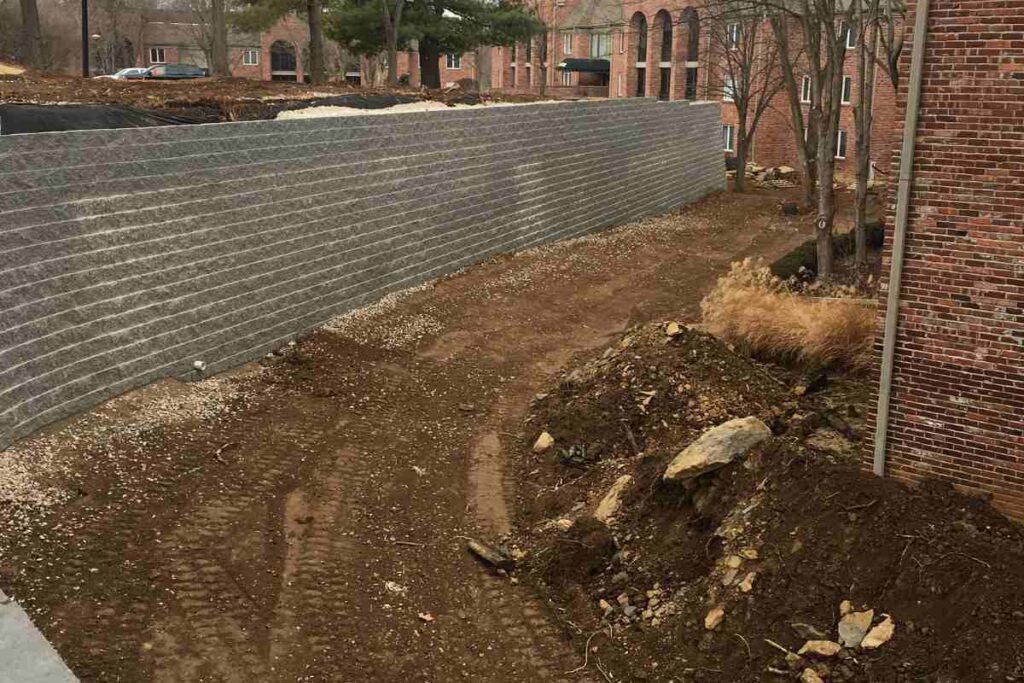
Three conditions require a retaining wall because no alternative can perform the structural function. Slopes exceeding a 3:1 grade, where the ground drops 1 foot vertically for every 3 feet of horizontal distance, cannot be regraded without encroaching on property lines, adjacent structures, or easements. The soil volume that would need to be redistributed on a steep grade typically exceeds the available space.
Sites where a level pad is needed for a patio, driveway, parking area, or building footprint at a grade change require a retaining wall to create the transition between elevations. Regrading creates slopes, not level surfaces. And sites where surcharge loads from vehicles, structures, or heavy equipment sit above a slope need a wall engineered to resist both the lateral earth pressure and the additional load. Plantings do not hold structural loads. Drainage does not hold soil in place.
Moderate slopes at 4:1 or gentler with no structural loads can often be managed without a retaining wall. Regrading runs $3 to $8 per square foot and works when the site has enough room to spread the soil to a stable angle. Slope stabilization plantings run $2 to $6 per square foot and control surface erosion on grades where the soil movement is shallow and weather-driven rather than structural.
French drain systems at $25 to $50 per linear foot address subsurface water but do not retain earth or create usable space. These alternatives cost 30% to 60% less than a retaining wall. Cost is not the only variable. The limitations are structural: none of these alternatives create usable square footage from a slope, and none support structural loads. All three require ongoing maintenance that a properly built retaining wall does not: plant replacement, drain cleaning, and periodic regrading as soil settles over time.