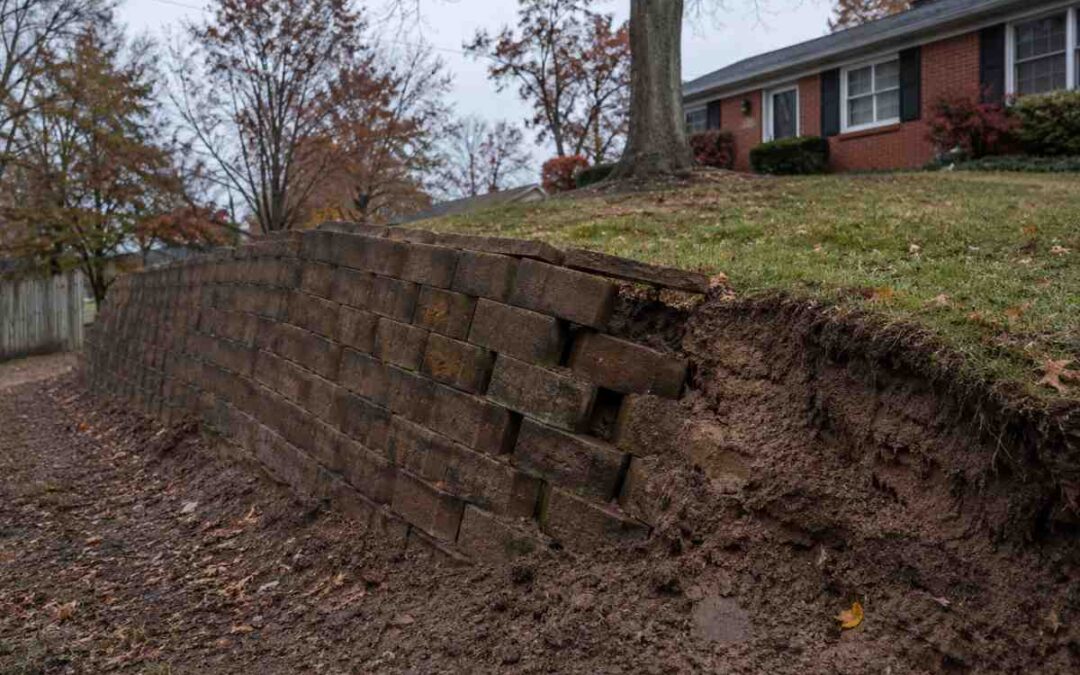
The lateral support doctrine is a common law property right that entitles every Missouri landowner to have their soil maintained in its natural position without being undermined by excavation, grading, or construction on adjacent land. When a retaining wall fails near a property line and causes soil movement, foundation cracking, or landscape erosion on a neighboring property, this doctrine determines whether the party who altered the grade faces strict liability or a negligence claim. Missouri applies strict liability when the damaged land was in its natural state at the time support was removed. When structures or improvements on the damaged property contributed to the collapse, courts require proof of negligence instead.
That obligation runs with the land. Both the landowner who ordered the excavation and the contractor who performed the work can be held jointly responsible. The same engineering and code compliance factors that shape liability analysis are why Retaining Wall & Paving Solutions includes PE-stamped drawings and permit package in every retaining wall project across the St. Louis metro area.
What Is the Lateral Support Doctrine in Missouri?
Missouri common law gives every landowner an absolute right to have their soil remain in its natural position without being undermined by excavation, grading, or construction on neighboring land. When a retaining wall fails, or when excavation or grading on neighboring land removes that natural support, the party who altered the grade faces strict liability for resulting damage to the adjacent land in its natural state. Lateral support is an absolute right attached to the land itself. It passes with ownership. A purchase agreement that includes a clause waiving lateral support rights is unenforceable because the right attaches to the land, not to the parties, and survives every transfer.
The damaged owner does not need to prove carelessness, poor workmanship, or failure to follow building codes. The fact that support was removed and land was damaged is enough to establish the claim. Intervening parcels do not block it.
The strict liability standard applies only to damage to land in its natural state. When improvements on the damaged property contributed to the collapse, Missouri courts shift to a negligence analysis. The burden shifts entirely. The excavating party must prove, typically through engineering assessment, that the neighbor’s building or improvement was the primary cause of subsidence.
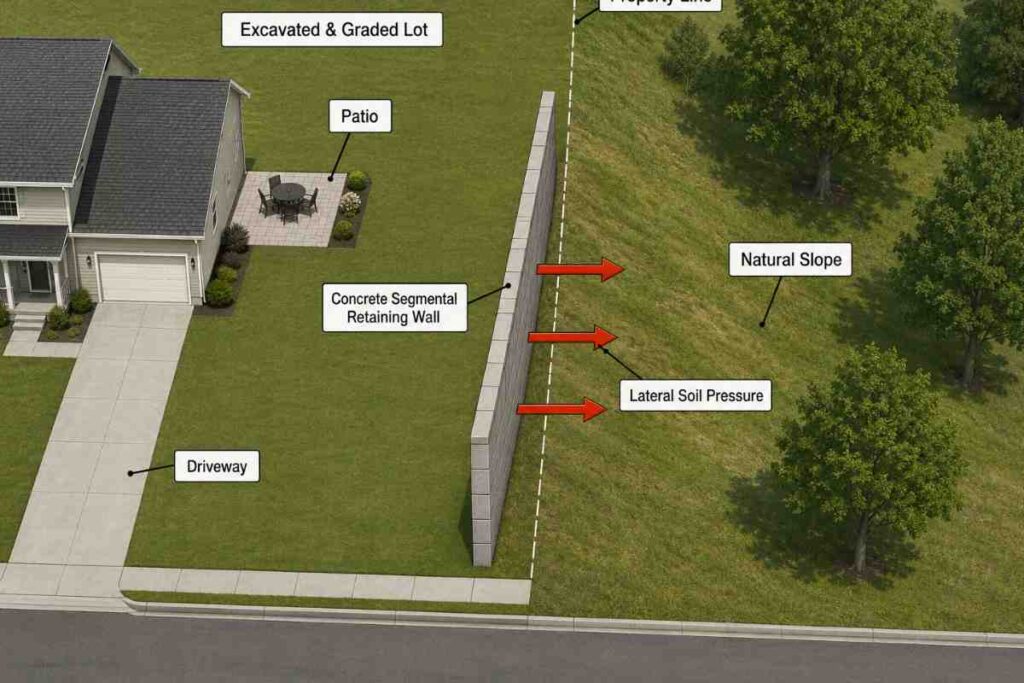
If the land would have collapsed even without those improvements, strict liability still applies. Whether the improvements caused the subsidence or the soil would have moved regardless is the central factual dispute in most retaining wall cases where both properties have been graded. Properties near a shared wall almost always have improvements on at least one side: a patio, a driveway, a shed, additional fill soil. Missouri courts evaluate the distinction using engineering evidence and site inspection findings. Missouri Geological Survey clay soil expansion data frequently supports these cases because expansive soil can mimic improvement-related subsidence.
The cause of action for loss of lateral support accrues when subsidence occurs, not when excavation happens. Missouri courts have held that a homeowner can bring a separate claim for each new occurrence of soil movement, even if a single excavation event caused multiple episodes of shifting over months or years. Each episode resets the clock.
Both the property owner who ordered the excavation and the contractor who performed the work can be held jointly liable for the resulting damage. A successor who purchases the property that caused the excavation is generally not liable for damage from that prior work. Courts make one exception. If the property was transferred specifically to avoid liability, the successor is not shielded.
Who Is Liable When a Retaining Wall Damages a Neighbor’s Property?
The party who excavated or altered the natural grade is primarily liable for damage caused by a failing retaining wall, regardless of which property the wall currently sits on. Current ownership of the wall is relevant but does not automatically determine liability. Who created the need for the wall does.
The downhill property owner typically bears responsibility. The downhill lot is almost always the one that was excavated or graded flat, creating the grade change that made the wall necessary. The obligation to maintain artificial support follows from having removed natural support.
- The person or entity that performed the original excavation holds primary liability, even if a subsequent owner now holds title to the downhill parcel.
- Liability transfers with ownership of that parcel because the wall replaces natural support that was removed, and maintaining that replacement is an obligation that runs with the land.
- If the downhill owner’s predecessor performed the excavation, the current owner inherits both the wall and the liability attached to it.
The obligation is not voluntary. It exists because the land was altered, and the wall is the mechanical replacement for the support that was removed. A downhill owner who neglects the wall allows the artificial support system to degrade, which re-exposes the uphill property to the subsidence conditions the wall was built to manage.
Liability can shift to the uphill property owner when post-construction changes increased the load beyond the wall’s design capacity. Missouri courts distinguish between damage caused by the original removal of support and damage caused by additional weight or pressure applied after the wall was built.
- Dumping fill soil, installing a pool, pouring a driveway, or adding a structure above the wall increases surcharge load that the original design may not have accounted for.
- Redirecting surface water or altering drainage patterns toward an existing retaining wall changes the hydrostatic pressure the wall must resist.
- If the wall fails under that added load, the uphill owner may bear partial or full responsibility for the damage.
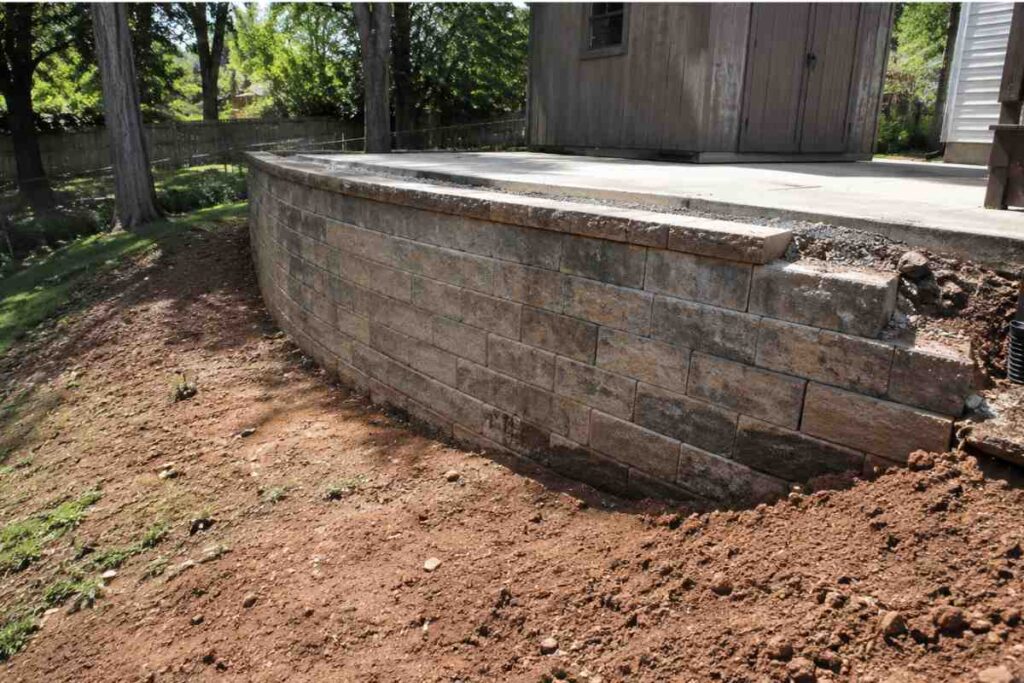
The analysis turns on one question: did the uphill improvements change the conditions the wall was designed to handle. The answer is site-specific. A wall engineered for a specific soil load and drainage pattern cannot be expected to perform when those conditions are altered after construction. Missouri courts evaluate whether the added surcharge or redirected water exceeded the wall’s original design parameters, and if so, the uphill owner bears the consequence.
Both the landowner and the contractor who built or excavated can be held jointly liable for loss of lateral support. Hiring an independent contractor does not insulate the landowner. Missouri treats the removal of lateral support as a non-delegable duty, which means the obligation cannot be transferred to a third party through a construction contract.
If multiple parties participated in the excavation or construction, each is liable for the joint tort. A homeowner who hires a landscaper or contractor to install a retaining wall that later fails and damages adjacent property remains liable alongside the contractor. The contractor’s independent status does not break the chain of liability back to the property owner who authorized the work.
Joint liability means the damaged neighbor can pursue either party or both for the full amount of the loss. The contractor cannot claim the homeowner directed the work. The homeowner cannot claim the contractor controlled the methods. Missouri law treats the act of removing lateral support as inherently the landowner’s responsibility, regardless of who held the shovel.
How Does Missouri Law Treat Surface Water Damage from a Retaining Wall?
Missouri courts analyze surface water diversion claims under nuisance law, not negligence. When a retaining wall blocks, redirects, or concentrates surface water onto a neighboring property, the damaged homeowner must prove that the wall owner’s use of their property was unreasonable and that the altered water flow caused measurable harm. The Missouri Supreme Court established this framework in Heins Implement Co. v. Mo. Highway & Transportation Commission (859 S.W.2d 681, 1993). The standard applies statewide.
Heins involved a government entity, not two neighboring homeowners. In Angeles v. Larson (249 S.W.3d 278, Mo. Ct. App. E.D. 2008), the Eastern District confirmed that the same nuisance framework applies between private residential property owners disputing surface water diversion. Unlike the lateral support doctrine, nuisance does not impose strict liability. The damaged party must demonstrate that the neighbor’s conduct was unreasonable, which requires evaluating the severity of the harm, the burden of preventing it, and whether the water diversion served a legitimate purpose.
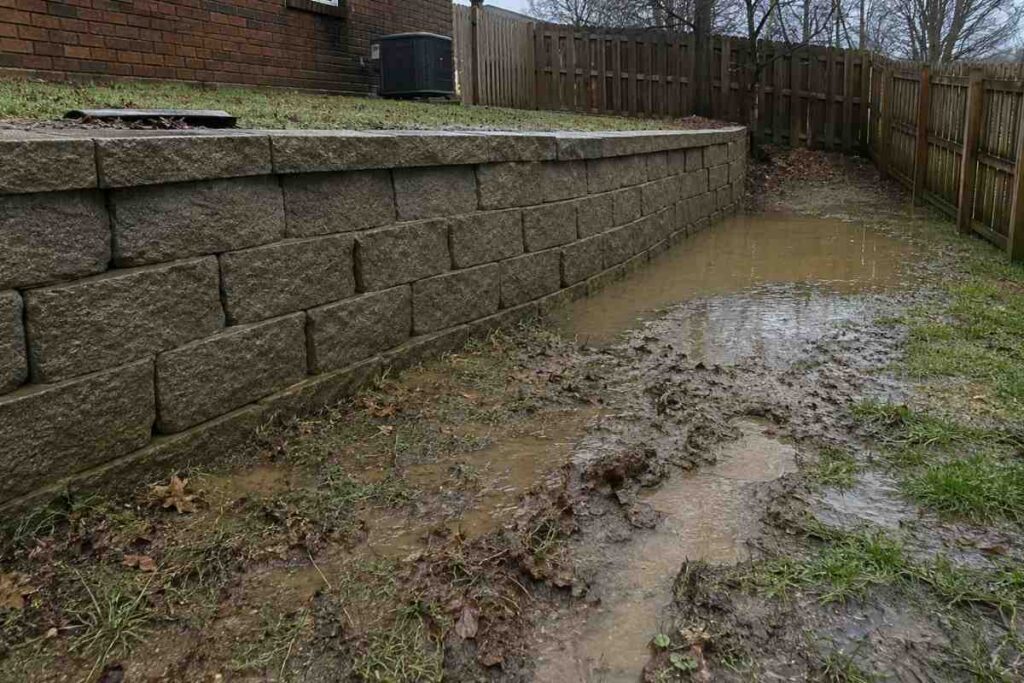
St. Louis County’s residential retaining wall checklist directly regulates how walls handle drainage. Walls must discharge onto flat areas such as lawns, drain away from buildings and adjoining properties, and not produce a nuisance. Walls cannot block or affect an existing swale or drainage path in a manner that causes damming or ponding. Ponding is a frequent complaint. Related grading must direct surface water to an approved watercourse or pipe it to a storm drain.
A code violation does not create automatic liability. It does, however, provide strong factual support for a nuisance claim because it demonstrates that the wall owner’s conduct fell below the standard the county adopted for reasonable drainage management. A wall built without following the checklist’s drainage provisions gives the damaged neighbor a concrete basis for arguing unreasonableness.
Missouri distinguishes between temporary and permanent nuisance, and the classification controls both the damages formula and whether the homeowner can file successive lawsuits. The distinction is not academic. It determines how much money is recoverable and whether the claim is a one-time recovery or an ongoing right.
Recovery for temporary nuisance is measured by diminished rental value during the period of harm, and the homeowner can file future claims if the condition continues. Recovery for permanent nuisance is measured by reduction in fair market value of the property, but bars all future claims. Homeowners pursuing private nuisance claims in Missouri recover damages under RSMo 537.296.
Whether a failing retaining wall constitutes a temporary or permanent nuisance depends on whether the condition can be abated. A wall that can be repaired or rebuilt to stop the water diversion is typically classified as temporary. A wall whose failure created an irreversible grade change, where the soil has permanently shifted and no reconstruction can restore the original drainage pattern, may be classified as permanent.
What Damages Can a Neighbor Recover for Retaining Wall Damage?
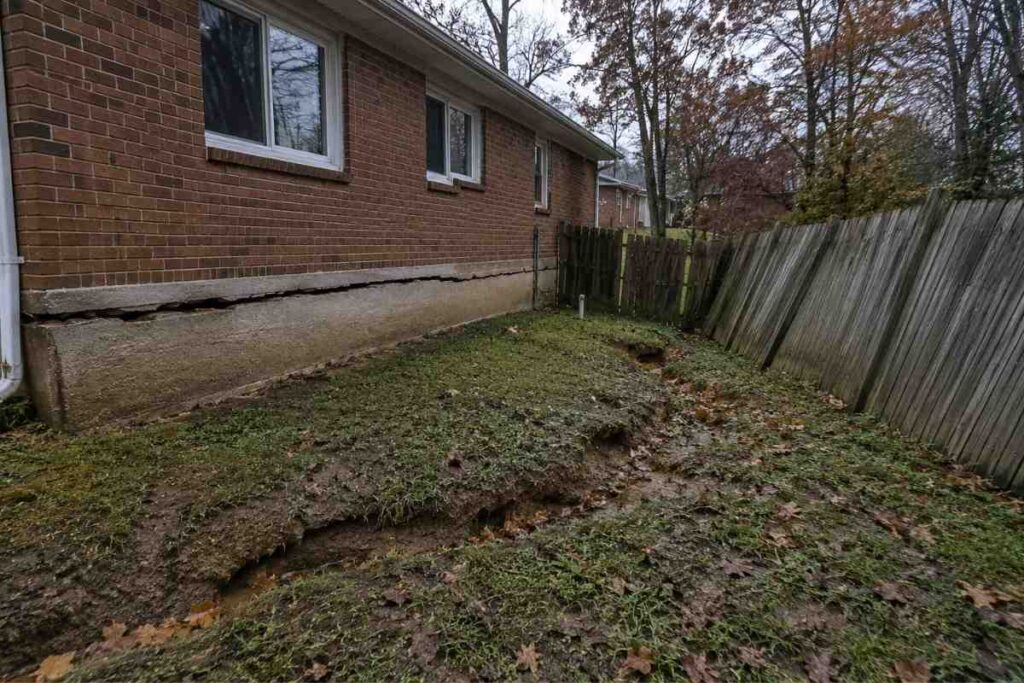
A Missouri homeowner whose property is damaged by a neighbor’s retaining wall can recover the diminution in property value for permanent damage, or the cost of repair plus lost use value for temporary damage. Both the excavating landowner and the contractor may be jointly liable for the full amount. Missouri courts have also awarded emergency stabilization costs and engineering assessment fees as ancillary damages when active soil movement threatened adjacent structures. The table below shows how damages are measured based on damage classification.
| Damage Classification | Measurement Standard | Recovery Scope |
|---|---|---|
| Temporary (condition can be abated) | Diminished rental value during the period of harm, plus cost of repair | Homeowner can file successive claims if the condition continues; recovery covers each period separately |
| Permanent (condition cannot be abated) | Reduction in fair market value of the damaged property | One-time recovery; bars all future claims for the same condition |
| Emergency and ancillary costs | Actual cost incurred | Emergency stabilization, foundation repair, landscape restoration, drainage correction, and engineering assessments needed to evaluate damage scope |
| Full replacement (extreme cases) | Replacement value of destroyed structure | Courts have ordered full replacement value when delay in constructing a retaining wall caused building collapse |
Missouri’s statute of limitations for property damage is five years under RSMo 516.120(4). The clock starts when the property owner discovers or should have discovered the damage, not when the excavation occurred. Discovery is the trigger.
For continuing trespass or continuing nuisance, recovery is limited to the five-year period immediately preceding the lawsuit filing, which means older damage falls outside the recoverable window even if the condition started decades earlier. A separate ten-year statute of repose under RSMo 516.097 applies to claims against architects, engineers, or builders connected solely to design, planning, or construction of an improvement. The repose period runs from the date of the improvement’s completion, not from the date of damage.
Claims specifically targeting how the contractor designed, engineered, or constructed the wall face the ten-year outer boundary under the statute of repose. After ten years from completion, the contractor’s exposure to design and construction claims ends regardless of when damage appeared.
Does Homeowners Insurance Cover Retaining Wall Damage?
Standard Missouri homeowners insurance covers retaining wall damage to a neighbor only when the damage results from a covered peril such as windstorm, fire, or vehicle strike. Earth movement, hydrostatic pressure, poor maintenance, and gradual deterioration are typically excluded. Most retaining wall failures near property lines fall outside coverage.
The personal liability section of a standard HO-3 policy covers damage you cause to a neighbor’s property, but only from covered perils. Most policies carry $100,000 to $300,000 in liability coverage, with higher limits available through endorsement. The other structures section may cover your own wall under the same peril restrictions.
- A windstorm that knocks a tree into the wall, a vehicle that strikes it, or lightning that damages the structure may trigger liability coverage for the neighbor’s repair costs.
- The earth movement exclusion in most HO-3 policies excludes damage from landslide, mudflow, subsidence, settling, and soil pressure, which covers the majority of retaining wall failure modes.
- A wall that fails because of drainage failure, root intrusion, freeze-thaw cycling, or age-related deterioration falls within the earth movement and gradual deterioration exclusions.
The exclusion pattern is broad. A retaining wall that collapses from soil pressure after years of clogged drainage does not produce a covered claim even if the owner maintained the wall in good faith. The earth movement exclusion does not ask whether the owner was negligent. It asks whether earth moved. If earth moved and the policy excludes earth movement, the claim is denied regardless of fault.
Concurrent causation exclusions add a second layer of coverage denial when multiple factors contributed to the wall’s failure. If a storm triggered the final collapse but the wall was already compromised by poor drainage and soil pressure, the insurer may deny the entire claim because an excluded cause contributed to the loss. The storm alone might have been a covered peril. Combined with an excluded cause, the claim fails.
The National Flood Insurance Program covers certain flood-related damage but typically excludes earth movement that accompanies flooding. Umbrella policies extend liability coverage beyond base HO-3 limits and may cover exposure that standard policies exclude. The time to discuss endorsements is before damage occurs.
What to Do After a Retaining Wall Fails Near a Property Line
Document the damage before anything else. Photograph and video the failure from multiple angles before any cleanup, stabilization, or repair begins. Then notify the adjacent property owner in writing, contact your homeowners insurance carrier, and hire a licensed Professional Engineer to assess the structural condition and the extent of soil movement.
The first priority is preserving evidence. Every photograph and video must be timestamped and captured from multiple angles and distances. Record the date, time, and weather conditions for each image. The documentation baseline you create in the first 24 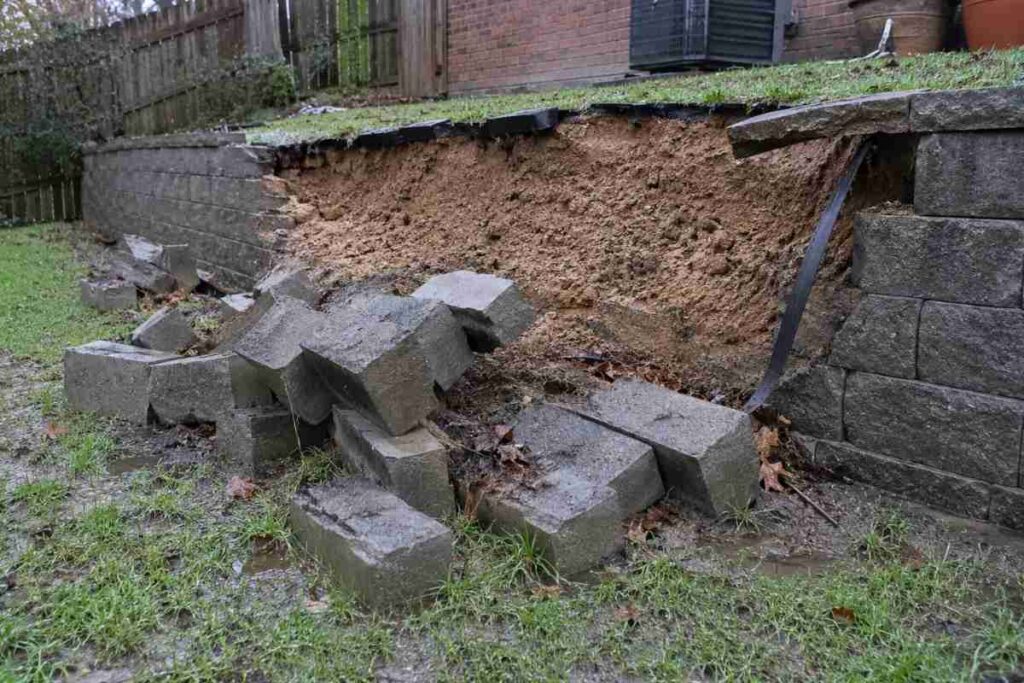 to 48 hours is the foundation for any liability or insurance claim that follows.
- Photograph and video the wall, the soil behind and below it, cracks in adjacent structures, displaced fences or landscaping, and drainage patterns visible after rain.
- Notify the adjacent property owner in writing, describing the observed condition and requesting access for inspection if the wall sits on their property.
- Contact your homeowners insurance carrier to open a claim even if you believe the damage may fall within the earth movement exclusion.
Filing the insurance claim produces its own record; the carrier’s denial, if it comes, may be relevant if coverage is later disputed. Once a contractor stabilizes or removes the failed section, the physical evidence of the failure mode vanishes: the drainage path behind the wall, the backfill condition, the footing exposure, and the soil saturation pattern are all destroyed by the repair itself. The documentation, the written notice, and the insurance filing each serve a separate evidentiary purpose, and delaying any one of them weakens the record.
The second priority is understanding what failed and why. A licensed Professional Engineer evaluates the wall’s structural condition, the extent of soil movement, and whether the failure poses ongoing risk to either property. The PE assessment identifies what drainage or grading corrections are needed and becomes the technical basis for any repair scope, liability claim, or insurance dispute.
- Hire a licensed PE to assess whether the wall can be repaired or must be replaced and whether adjacent structures are compromised.
- Request the original building permit records from St. Louis County Department of Public Works or the applicable municipality.
Permit history shows whether the wall was built to code with engineering review and required inspections. No permit for a wall exceeding the county’s height or property line distance thresholds is more than a code gap. The absence of permitting may support a negligence claim because it demonstrates that the standard of care for walls at that height, including engineered drawings, PE review, and code-compliant drainage, was not met during original construction. A PE evaluates the wall against those standards.
How Do Missouri Building Codes Affect Retaining Wall Liability?
A retaining wall built without required permits, engineering, or inspections does not automatically trigger liability, but code noncompliance is strong evidence of negligence in a Missouri property damage claim. St. Louis County adopted the 2015 International Residential Code and International Building Code with local amendments under Ordinance #27,654. The adopted codes establish the engineering and permitting standards that govern retaining wall construction across unincorporated St. Louis County and municipalities that follow county code adoption.
A building permit is required under the county’s retaining wall checklist when any wall exceeds 3 feet in height or when the wall’s distance from a property line is less than or equal to its height. Height is measured from top of grade at the base to grade on the retained side at the top. Walls built from materials other than wood railroad ties also require permits regardless of height.
The City of St. Louis applies a 4-foot threshold under IBC 1807.2. Walls exceeding these thresholds without permits, PE-stamped drawings, and required inspections were built in violation of adopted code. That violation is evidence of negligent construction.
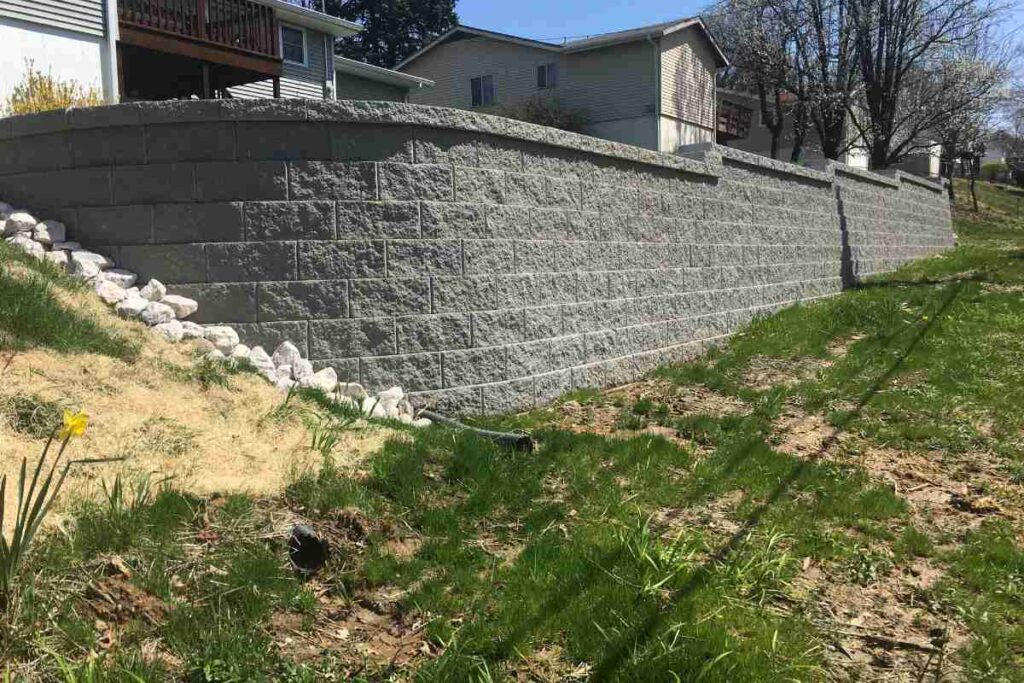
Code noncompliance does not create strict liability by itself. It creates a rebuttable presumption of negligence or serves as evidence that the wall builder failed to meet the standard of care. The distinction matters. A rebuttable presumption means the violation shifts the burden of proof to the builder, who can still demonstrate that the wall was structurally adequate despite the permit gap.
A wall built to code with proper permits and engineering is not immune from liability either. If the owner allowed drainage to fail, added surcharge loads beyond the design capacity, or neglected routine maintenance, the current owner may still be liable under the lateral support doctrine or nuisance theory. Code compliance at construction does not excuse what happened afterward.
The analysis works in both directions. A code violation strengthens a negligence claim but does not guarantee one. Code compliance weakens a negligence claim but does not defeat one. The wall’s current condition, maintenance history, and post-construction changes to load or drainage determine the outcome more than the permit file.
How to Reduce Liability Exposure Before a Retaining Wall Fails
The most effective way to reduce retaining wall liability exposure is to hire a licensed PE to assess any wall near a property line before it shows signs of failure, verify that drainage systems are functioning, and confirm the wall meets current code requirements for height, setback, and engineering design. Every liability theory covered in this guide, from the lateral support doctrine through nuisance and code noncompliance, traces back to a physical condition that a proactive assessment can identify.
A PE assessment evaluates whether an aging retaining wall can continue to perform under current loads and soil conditions. The assessment is not a visual inspection. It examines the structural, drainage, and regulatory factors that determine whether the wall is a liability or a functioning support system.
- Evaluate wall tilt or displacement, footing integrity, and whether the base has shifted since original construction.
- Test drainage function: French drain flow, weep hole clearance, and gravel backfill condition behind the wall.
- Identify surcharge loads added since the wall was built, including patios, driveways, sheds, and fill soil that increase pressure beyond original design capacity.
- Determine whether tree roots have compromised the drainage system or the wall structure itself.
- Verify the wall’s location relative to the property line with a professional survey.
- If any portion of the wall crosses the property line, a recorded construction and maintenance easement is required per St. Louis County policy.
Prevention is cheaper than litigation. Addressing drainage, structural, and code issues before failure occurs eliminates the factual basis for most neighbor liability claims. A wall built without permits or engineering should be evaluated against current code standards, not the standards that may or may not have applied at the time of construction. The proactive assessment converts an unknown liability into a documented condition with a defined scope of work. What the homeowner does with that information determines whether the wall remains an exposure or becomes a resolved condition.