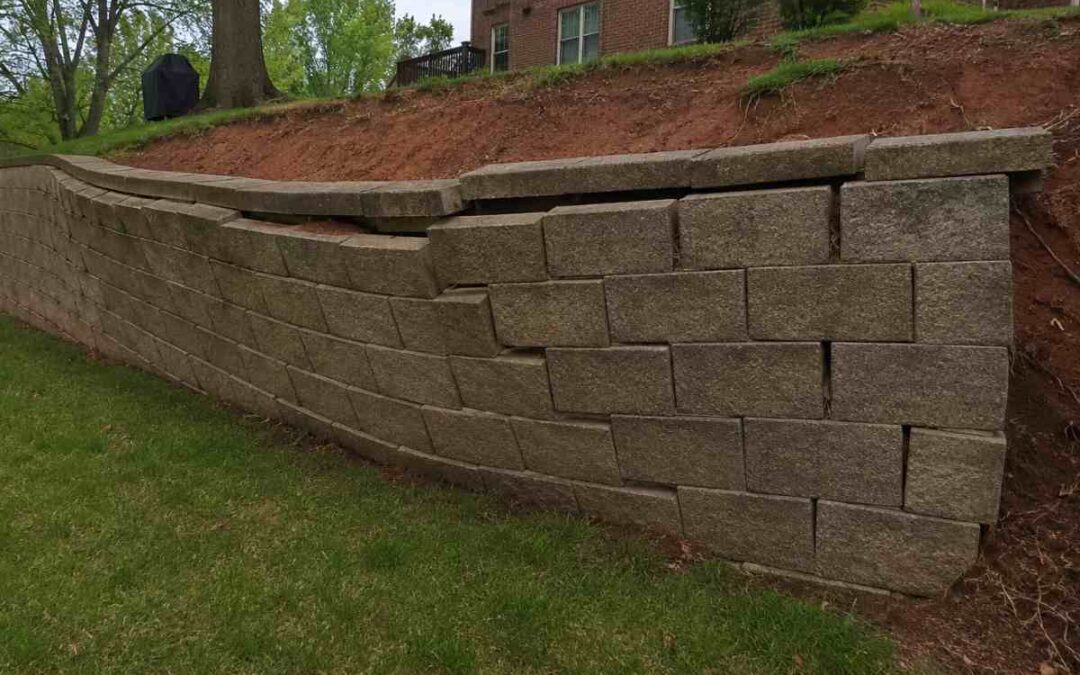
Retaining wall repair is the process of restoring a damaged or failing earth-retaining structure to its original load-bearing capacity and alignment. St. Louis metro properties sit on Pennsylvanian-era clay formations where moisture content in the top 6 to 8 feet of soil can swing 15% or more between spring saturation and late-summer drought. These smectite-rich clays swell when saturated and shrink during drought, generating cyclical lateral pressure that pushes walls beyond their design limits over repeated seasons. That pressure shows up as leaning, bowing, and cracking through the wall face. When the drainage system behind the wall has failed or was never installed, water migrating through the masonry accelerates every one of those symptoms. Movement accumulates across years of wet-dry cycling before it reaches the point where a visual inspection from grade level can detect it.
Retaining Wall & Paving Solutions employs a licensed professional engineer who evaluates wall failures across St. Louis City, St. Louis County, St. Charles County, and Jefferson County. A structural assessment identifies what caused the failure, whether the wall can be stabilized, and what the repair will cost relative to full replacement.
What Causes Retaining Walls to Fail in St. Louis?
Retaining walls in the St. Louis metro fail primarily because expansive clay soils swell under moisture and shrink during dry periods, generating lateral pressure cycles that exceed the wall’s design capacity. That failure accelerates when compounded by inadequate drainage, freeze-thaw stress, and insufficient footing depth.
Three conditions account for the majority of retaining wall failures across St. Louis City and St. Louis County:
- Expansive clay soil that generates cyclical lateral pressure against the wall face through seasonal moisture swings
- Drainage failure that allows hydrostatic pressure to build behind the wall with no relief path
- Construction-origin deficiencies where footings, reinforcement, or backfill were inadequate for the site’s actual soil and load conditions
Smectite clay is the dominant soil type across much of the St. Louis metro. Its behavior is the single largest factor in wall failure. When this clay absorbs water during spring rains or prolonged wet periods, it expands and pushes laterally against the back of the wall.
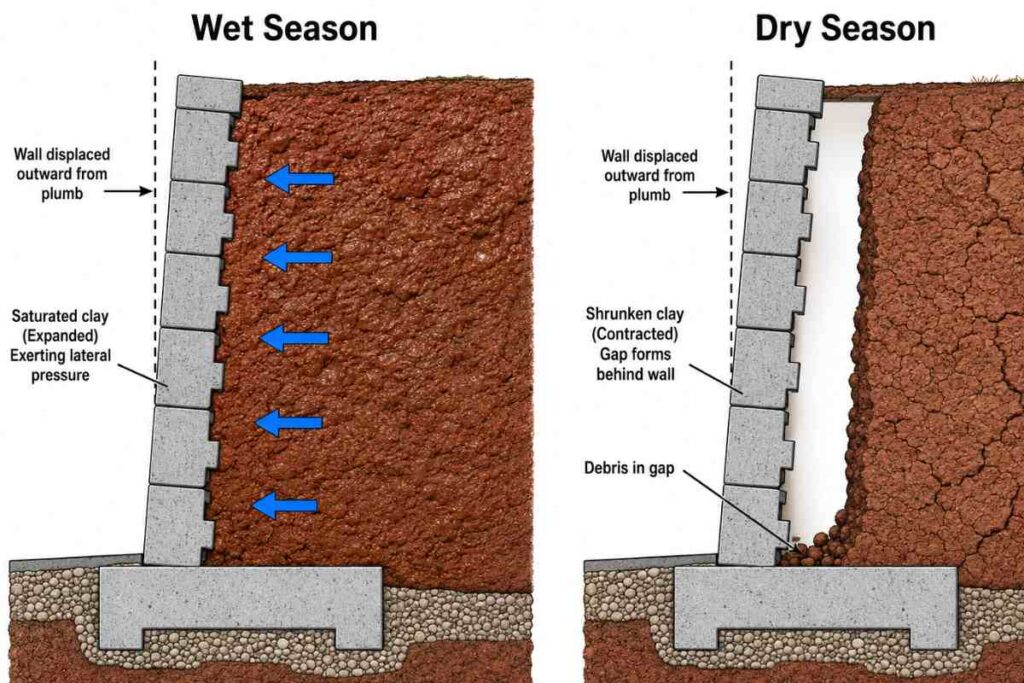
Drought reverses the process. The clay shrinks, pulls away, and leaves voids that fill with loose soil and debris. Each wet-dry cycle pushes the wall incrementally outward, and the soil behind it consolidates into the gap so the wall cannot return to plumb even when the pressure subsides. That displacement is permanent. Over five to ten years of these one-way shifts, the cumulative movement exceeds what the wall’s design tolerances allow, even on walls that were properly built.
Hydrostatic pressure is the force that water exerts against a surface when it has no drainage path. Behind a retaining wall, this pressure builds when water saturates the backfill and cannot escape through weep holes, drain tile, or granular drainage aggregate.
St. Louis clay soils make this worse. Clay holds moisture instead of draining, so water stays trapped against the wall through entire wet seasons rather than percolating downward. University of Missouri Extension soil data confirms that expansive clays in the St. Louis basin can exert lateral pressures exceeding what many residential walls are designed to handle [NEEDS SOURCE for specific publication and psi figures]. Saturated clay behind a 4-foot wall can push combined lateral loads past 300 pounds per linear foot at the base. Drainage design governs whether that wall survives its first decade.
Walls built without engineered footings set below Missouri’s frost line of 30 to 36 inches are vulnerable to heave. Frost penetrates below the footing, the ground lifts unevenly, and the structure cracks along the bond lines between courses. That damage is permanent.
Walls over 4 feet that lack geogrid reinforcement layers tied back into compacted backfill depend entirely on their own mass for stability, which is rarely sufficient in expansive soil. Surcharge loads from driveways, retaining structures above the wall, or additional slope add lateral force beyond what the soil alone generates, and walls not engineered for that extra load fail faster. Backfill matters just as much. Walls backfilled with the same excavated clay trap moisture directly against the wall and drainage system, defeating both. Footing depth and bearing capacity for retaining structures must meet the standards in IBC Section 1807, and walls that fall short carry structural risk from the day they are built.
How Do You Know Your Retaining Wall Needs Repair?
A retaining wall needs repair when it shows structural movement such as leaning, bowing, or bulging, develops horizontal or stair-step cracking, separates from the retained soil behind it, or displays water seepage through the wall face. Cosmetic issues like minor efflorescence or hairline settling cracks do not indicate structural failure.
Three categories of visible damage tell you whether your wall has a cosmetic problem or a structural one:
- Structural movement where the wall is leaning, bowing, or shifting out of its original alignment
- Cracking patterns that reveal whether the wall is failing under lateral pressure, settling unevenly, or expanding thermally
- Water and drainage indicators that signal the system behind the wall has failed
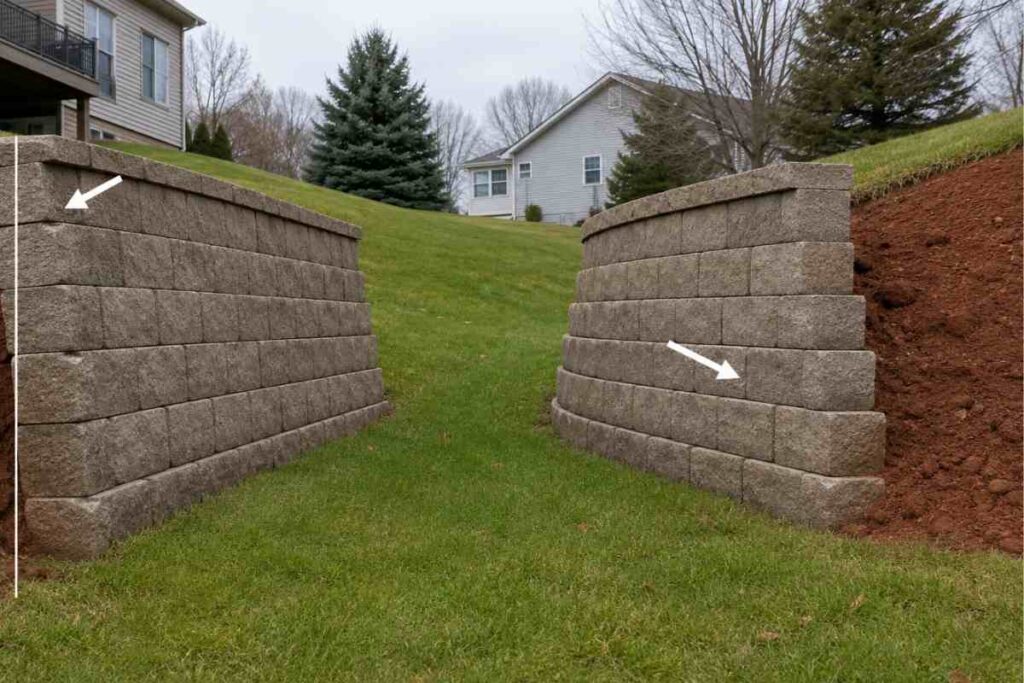
A wall that is leaning, tilting off vertical, or bowing outward at mid-height has lost the ability to resist the lateral load behind it. Top cap displacement is the earliest visible sign because caps sit on the wall by gravity alone and shift before the wall face shows measurable movement. Bowing at mid-height is more dangerous than leaning at the top. A wall that bows is being pushed outward at the point of maximum soil pressure, which means the failure is happening at the structural core rather than at the surface.
Any wall showing progressive movement needs assessment before it reaches the point where controlled repair is no longer possible. A wall that moved a quarter inch last year and a half inch this year is accelerating.
Horizontal cracks running along a mortar joint line mean the wall is failing to resist lateral soil pressure at that specific elevation. The soil is pushing harder than the wall can hold at that height.
Stair-step cracks through mortar joints follow the path of least resistance diagonally through the wall and indicate differential settlement or foundation movement underneath the structure. Vertical cracks are the least structurally alarming when they are narrow and stable. They typically result from thermal expansion and contraction or minor settling, and a vertical crack that has not widened over two seasons is usually cosmetic. A vertical crack that is widening, however, may indicate a deeper footing or soil issue and should not be dismissed without inspection.
Water seeping through the wall face is the most reliable indicator that the drainage system behind the wall has failed or was never installed. Persistent wet soil at the base of the wall, even during dry weeks, signals that water is migrating through or under the structure rather than draining away from it. Efflorescence, the white mineral staining that appears on masonry surfaces, forms when water passes through the wall material and deposits dissolved salts on the face as it evaporates.
Efflorescence alone is cosmetic. But when it appears alongside seepage, base erosion, or visible soil washing out from behind the wall, the pattern points to a drainage system that is no longer controlling water. Timber walls show the equivalent warning through soft or crumbling members, particularly at ground contact points where moisture accelerates rot. The hydrostatic pressure that builds behind an undrained wall is often the force that triggers the movement and cracking this section covers.
What Are the Most Common Retaining Wall Repair Methods?
The most common retaining wall repair methods in St. Louis fall into two categories: surface-level repairs and drainage corrections that address cosmetic damage and the root cause of most failures, and structural stabilization systems that restore load-bearing capacity to walls with significant movement.
Surface and Drainage Repairs
Surface repairs include mortar repointing, crack sealing with masonry caulk, and replacement of individual damaged blocks or timbers. Drainage repairs involve installing or clearing weep holes, retrofitting perforated drain pipe behind the wall, replacing saturated backfill with free-draining gravel, and regrading the soil above the wall to redirect surface water.
These two repair tiers address different problems, and knowing which one your wall needs determines whether the fix lasts:
- Mortar repointing and crack sealing for deteriorated joints and stable, non-widening cracks
- Individual block or timber replacement where material has degraded but the wall structure is sound
- Weep hole installation or clearing to restore drainage relief through the wall face
- Perforated drain pipe retrofit with filter fabric and washed gravel backfill behind the wall
- Surface regrading above the wall to redirect water away from the retained soil
Mortar repointing fills joints that have crumbled from freeze-thaw cycling or moisture penetration. Where cracks are stable and not widening, flexible masonry caulk seals them without requiring joint removal. Individual block replacement is the most limited of the three. It works only when a section of facing has spalled, shifted, or broken without pulling the surrounding courses out of alignment. These surface repairs share one hard boundary.
They apply only when the wall is not showing structural movement. A repointed joint on a wall that is actively leaning or bowing will crack along the same joint line within one to two wet-dry cycles because the wall moves enough to reopen what was just sealed. The repair addresses the surface while the lateral pressure behind the wall continues to displace the structure. Surface repair on a moving wall is not a repair. It is a delay.
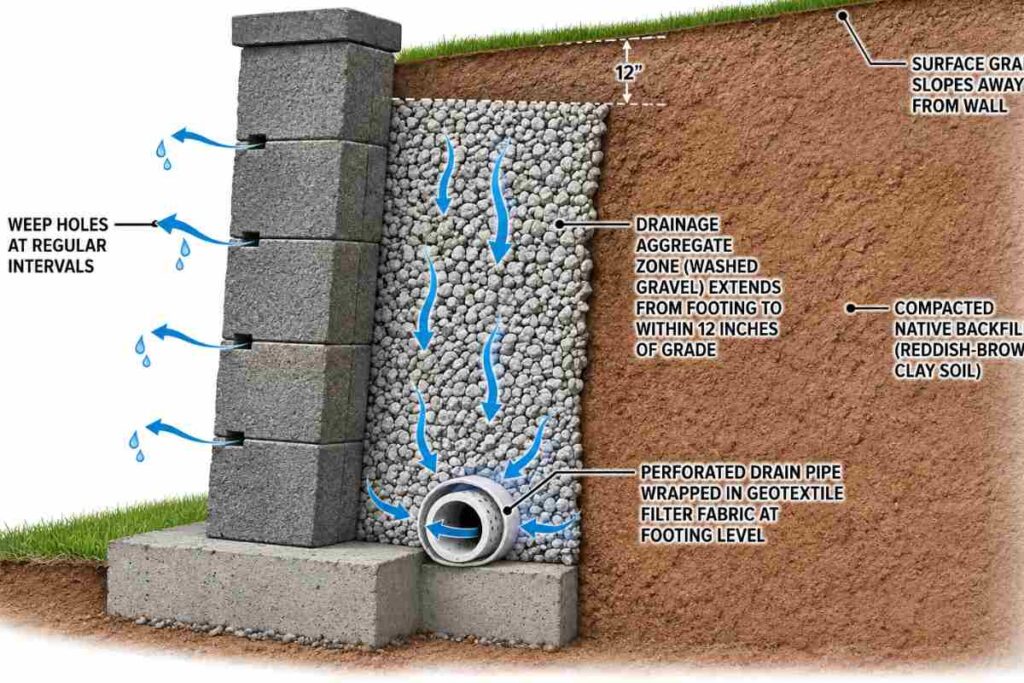
Drainage failure is the root cause behind most retaining wall problems in St. Louis clay soil, and fixing the drainage system is often the single intervention that stops a wall from getting worse. The retrofit means excavating to the footing, stripping the backfill, and laying drain pipe along the base. This pipe-and-gravel assembly, sometimes called a French drain, works as a continuous relief channel at the wall’s most pressure-critical elevation. The pipe is wrapped in filter fabric, a geotextile membrane that allows water through while blocking soil particles from clogging the system over time.
Washed gravel replaces the excavated clay. It drains freely instead of holding moisture against the wall. Weep holes at 4-to-6-foot intervals give trapped water a path out before hydrostatic pressure builds. Regrading the soil surface above and behind the wall redirects runoff away from the retained area. The NCMA Design Manual for Segmental Retaining Walls, 3rd Edition, specifies drainage aggregate depth, pipe diameter, and filter fabric requirements for segmental wall systems.
Structural Stabilization Systems
Structural stabilization uses mechanical anchoring systems driven into stable soil to arrest wall movement. These systems restore load-bearing capacity to walls showing two or more inches of outward displacement without requiring full demolition and replacement.
Three anchor types account for the majority of structural retaining wall repairs:
- Helical tiebacks drilled through the wall into competent bearing soil at a downward angle
- Plate anchors using a buried steel plate connected to the wall face by a threaded rod
- Deadman anchors using a buried cross-member to resist outward pressure on shorter walls
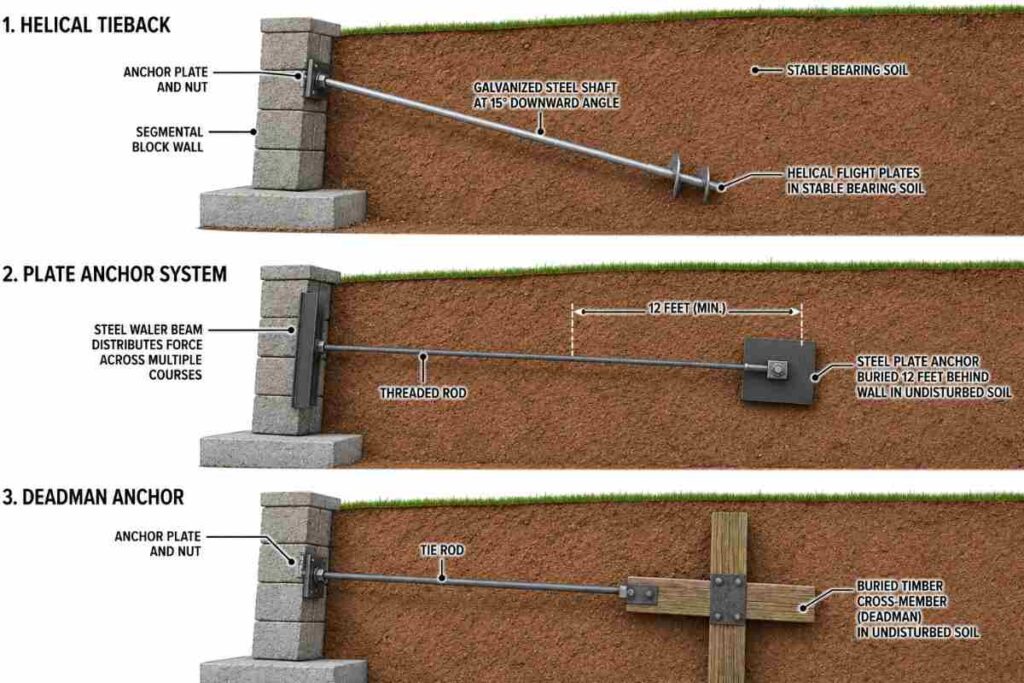
Helical tiebacks are galvanized steel shafts driven through the wall at a downward angle until they reach stable bearing soil. The installer measures torque resistance during installation to confirm holding capacity per ASTM D3689. Tiebacks work on concrete, block, and timber walls where the material is sound enough to accept the anchor plate without cracking under load.
Plate anchors use a steel plate buried 10 to 15 feet behind the wall in undisturbed soil. A threaded rod connects that plate through the wall to a steel waler beam on the face, spreading the restraining force across multiple courses rather than concentrating it at one point. Deadman anchors are the simplest option. They use a buried timber or concrete cross-member as a passive resistance element and suit shorter walls where the backfill zone is accessible. Without anchoring, a wall with active movement will continue displacing until repair is no longer viable and full replacement is the only path. A structural or geotechnical engineer determines anchor type, spacing, and depth based on wall height, soil conditions, and load.
How Much Does Retaining Wall Repair Cost in St. Louis?
These are national averages. St. Louis clay soil conditions increase excavation difficulty and drainage scope on most repair projects, which affects the labor portion of any bid:
- Surface repairs such as crack filling, repointing, and block replacement: $100 to $500
- Drainage system repairs including excavation, pipe installation, and backfill replacement: $60 to $70 per linear foot
- Structural stabilization with anchoring and foundation reinforcement: $60 to $115 per square foot
- Full wall replacement: $6,000 to $14,000
- Structural engineer inspection: $100 to $220 per hour
Surface repairs are the lowest-cost tier because the wall structure stays in place. Crack filling with masonry caulk and mortar repointing for deteriorated joints typically fall between $100 and $300 based on national averages for residential walls. Block replacement runs higher when multiple courses need resetting, but a localized section rarely exceeds $500. Mason and contractor labor runs $50 to $75 per hour nationally before materials, equipment, and disposal.
Drainage system repairs cost more because they require excavation. Digging to the footing, removing saturated clay backfill, installing drain pipe and gravel, and restoring the grade runs $60 to $70 per linear foot based on Angi 2026 data for drainage excavation. A 40-foot wall section needing full drainage retrofit lands between $2,400 and $2,800 at that rate.
Structural stabilization is the highest-cost repair tier and the one most affected by St. Louis soil conditions, because clay excavation and deeper anchor depths add time and equipment that sandy or loam soil regions do not require. Foundation anchoring runs $60 to $80 per square foot, and projects requiring excavation and foundation thickening push total costs to $95 to $115 per square foot based on Angi 2026 data.
Walls over 4 feet need engineer review at $100 to $220 per hour to set the repair scope. Permit fees apply when the repair involves rebuilding load-bearing sections above 3 feet or modifying the wall’s structural capacity, ranging from $50 to $450 depending on the municipality. Demolition of failed wall sections adds $10 to $20 per linear foot before replacement work begins.
Sloped lots with limited equipment access add labor time. A crew that can reach the wall base with a compact excavator finishes in half the time of one working by hand on a steep grade.
Should You Repair or Replace Your Retaining Wall?
Repair your retaining wall when the structural core is intact, the damage is localized, and the root cause is correctable. Replace the wall when repair costs exceed 50% of replacement cost, when the wall has failed repeatedly after prior repairs, or when the original construction lacked adequate footing, drainage, and reinforcement for the site’s soil conditions. Poor drainage is the most common cause of retaining wall failure according to an FHWA-funded study conducted through the University of Missouri, and whether the drainage problem can be corrected often determines which side of this decision a wall falls on. A structural engineer assessment resolves borderline cases where the wall’s condition does not clearly favor either path.
| Criteria | Repair | Replace |
|---|---|---|
| Damage scope | Localized to a defined section. The wall is not showing progressive movement across its full length. | Wall is leaning or bowing across its full length, or damage spans multiple sections with no stable zone between them. |
| Cost threshold | Repair cost is well below 50% of full replacement cost. This is an industry convention, not a formal standard, but it reflects the point where the remaining wall life no longer justifies the repair investment. | Repair cost exceeds 50% of replacement cost. At that ratio, a new wall built to current engineering standards is the better structural and financial outcome. |
| Original construction | Footing and base are stable. The wall was built with adequate depth, drainage provisions, and reinforcement for the site. The failure is from wear or a correctable condition, not from a design flaw. | Original construction lacked engineered footings, drainage, or reinforcement. The wall was underbuilt for the site’s soil and load conditions from the start, and no repair corrects a design-origin deficiency. |
| Material condition | Wall material is structurally sound. Surface degradation (spalling, minor rot, joint deterioration) has not compromised the core. | Material has reached end of life. Timber rot throughout the structure, concrete spalling across the full face, or block degradation beyond individual replacement. Typical material lifespans: timber 20 to 40 years, concrete 50 to 100 years, segmental block 50+ years. |
| Drainage | Root cause is correctable. Drainage can be added, backfill can be replaced, weep holes can be installed or cleared. The wall responds to the fix. | Drainage system cannot be retrofitted without demolishing the wall, or prior drainage repairs have failed to stop water-driven deterioration. |
| Load requirements | The wall’s current load matches its original design. No new surcharge has been added since construction. | The wall must now carry a surcharge load it was never designed for, such as a driveway, structure, or additional slope added after the wall was built. |
Do You Need a Permit to Repair a Retaining Wall in St. Louis?
Minor surface repairs like crack filling and repointing typically do not require a permit. Repairs that involve rebuilding load-bearing wall sections, modifying the wall’s height, or reconstructing the footing trigger St. Louis County’s building permit requirement when the wall meets any of the threshold conditions below.
St. Louis County requires a building permit for a retaining wall when any one of these conditions applies:
- The wall height exceeds 3 feet, measured from grade at the base to grade on the retained side
- The wall exceeds 2 feet and carries a surcharge load from a driveway, pool, or structure above it
- The wall’s distance from a property line is less than or equal to its height
- A fence or guardrail on top of the wall creates a combined height exceeding 6 feet
Repairs that involve partial demolition and rebuilding of sections meeting any of these thresholds trigger the same permit requirements as new construction. The St. Louis County Department of Public Works administers these permits for unincorporated areas and for municipalities that contract with the county for code enforcement services. Walls over 4 feet in height also require a 42-inch guardrail or other approved protective barrier when located within 2 feet of a sidewalk, path, parking area, or driveway on the high side.
That guardrail requirement catches homeowners off guard. It applies to the finished condition, not just during construction.
Walls over 4 feet require structural drawings sealed by a Missouri-licensed professional engineer under RSMo Chapter 327. Pre-approved segmental retaining wall master plan systems on file with St. Louis County can simplify the permit process for walls up to 6 feet in a single tier or 8 feet total in two tiers. The property owner or contractor notes the manufacturer’s master plan number on the permit application, eliminating the need for custom engineering drawings within those height limits.
Zoning approval from the contracting municipality is required regardless of whether a county building permit applies. St. Louis City handles permits through a separate Building Division. Any repair that alters the wall’s load-bearing capacity or height falls under the same code provisions as new construction per the 2015 IRC Section R404, adopted by St. Louis County with local amendments.
What Should You Look for in a Retaining Wall Repair Contractor?
A qualified retaining wall repair contractor diagnoses the failure cause before proposing a repair method. The contractor should have access to a structural or geotechnical engineer, hold NCMA certification for segmental retaining wall work, carry current Missouri contractor licensing and insurance, and provide a written scope that identifies what failed and why before specifying how to fix it.
Five markers separate a contractor who will fix the problem from one who will treat the surface:
- Diagnoses the failure cause (drainage, footing, soil, construction deficiency) before proposing the repair method
- Has a Missouri-licensed PE on staff or under direct contract for walls requiring engineered repair per RSMo Chapter 327
- Holds NCMA certification confirming competence in segmental retaining wall engineering and installation standards
- Carries general liability and workers’ compensation insurance with current coverage
- Provides a written warranty that specifies coverage duration, exclusions, and conditions
The diagnosis comes first. A contractor who walks a property, looks at the wall face, and proposes repointing or crack sealing without checking the drainage system, footing condition, or backfill material is treating a symptom. The cause is still behind the wall. Qualified contractors excavate a test section or use a probe to evaluate what is happening at the base and behind the face before they quote a repair method. The PE requirement is not optional for walls over 4 feet. Missouri law under RSMo Chapter 327 requires a sealed by a professional engineer structural wall designs, and a contractor without engineering access on projects that require it is operating outside the regulatory framework.
Written warranty terms matter because they define what happens when a repair does not hold. A warranty that specifies 10 years of coverage with named exclusions for drainage modifications, soil conditions, and owner-caused damage gives the homeowner a clear standard to evaluate against. A warranty with no exclusions listed or no duration specified is a promise without structure.
Contractors who cannot explain the lateral load conditions driving the failure are the highest-risk choice. A wall is not just leaning. Something is pushing it. If the contractor cannot name what that force is and how the proposed repair resists it, the repair will fail. Cosmetic repair on a wall showing structural movement will crack along the same lines within one to two wet-dry cycles in St. Louis clay soil. The wall will keep moving unless the repair addresses load, drainage, or both.
The difference between a repair that lasts and one that fails within two years is whether the contractor fixed what you can see or fixed what caused it.
How Can You Prevent Future Retaining Wall Damage?
Prevent future retaining wall damage by inspecting the wall twice per year, keeping weep holes and drain outlets clear of debris, maintaining proper grading so surface water flows away from the wall, and keeping tree and shrub root systems at least 3 feet from the wall face. Most wall failures that follow a repair trace back to one of these maintenance actions being skipped.
Six maintenance actions protect a repaired wall from recurring damage:
- Inspect the wall face for new cracks, movement, or block displacement twice per year and after every significant storm
- Check that weep holes and drain outlets are flowing freely and clear of soil or debris buildup
- Look for soil erosion at the base or gaps forming between the wall and the retained soil behind it
- Address minor cracks and repoint deteriorated mortar joints before water infiltration accelerates damage
- Reapply masonry sealant every 2 to 3 years on concrete and block walls to slow moisture penetration
- Maintain polymeric sand in paver-faced or dry-stacked walls to keep joints sealed against water and insect intrusion
Spring and fall are the two inspection windows that matter most in St. Louis. Spring inspection catches damage from freeze-thaw cycling over winter and evaluates whether the drainage system handled snowmelt and early rain. Fall inspection catches cracks or movement from summer drought, when clay shrinkage pulls soil away from the wall. Waiting longer than a full seasonal cycle to inspect means damage from one season compounds into the next before anyone sees it.
Post-storm checks are separate from the biannual schedule. A heavy rain event can overwhelm a drainage system that was functioning under normal conditions and push enough water behind the wall to trigger movement in a single event. The check takes five minutes. Walk the base, look for new wet spots or soil washing out, scan the face for fresh cracks.
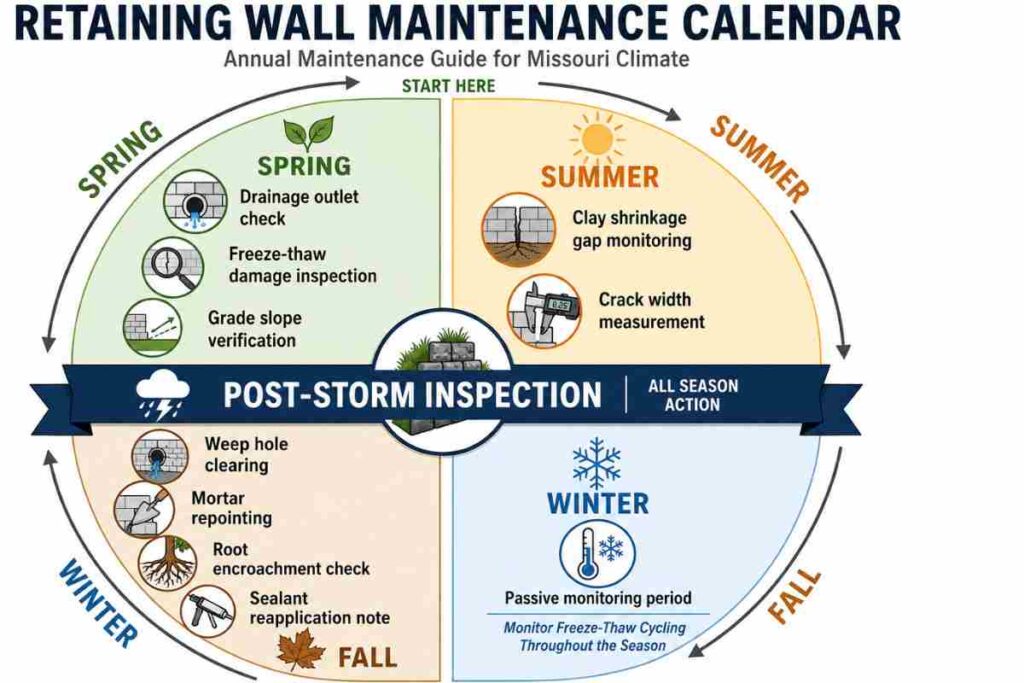
Grading above and behind the wall is the maintenance action homeowners most often neglect. Over time, soil settles, mulch accumulates, and landscape additions redirect water toward the wall rather than away from it. The grade should slope away from the retained side so surface water drains to a lawn, swale, or storm system rather than pooling against the backfill zone.
Root management starts at planting. Trees and large shrubs planted within 3 feet of the wall face will eventually send roots into the drainage aggregate, the drain pipe, and the joints between wall courses. Root systems create three problems at once: they displace wall components through physical pressure, clog the drainage path that prevents hydrostatic buildup, and create uneven soil moisture conditions that amplify the clay expansion pressure this entire guide has described. Remove encroaching root growth before it reaches the drainage system. Once roots are inside the drain pipe or aggregate layer, clearing them requires the same excavation as a full drainage retrofit.