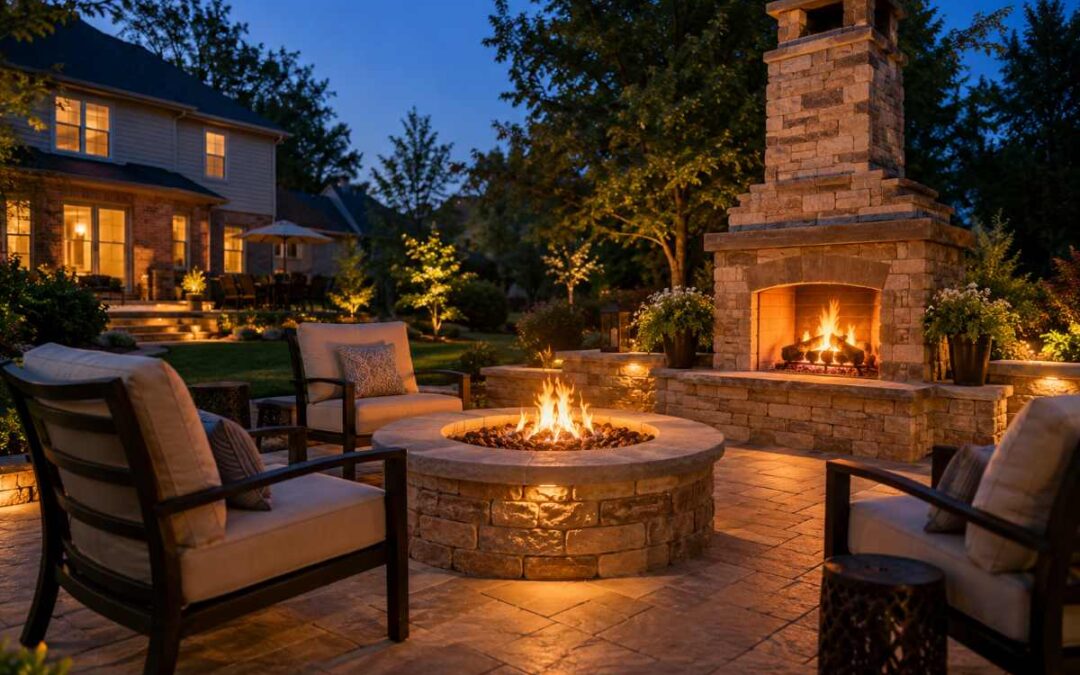
An outdoor fire feature is a built or set hearth that holds a controlled fire on a patio or in a yard, for warmth and for gathering. The two common forms are the fire pit and the outdoor fireplace. They look alike. They do not behave alike once the fire is lit.
A fire pit wins the social evening. It throws heat in a full circle, so a ring of chairs all share the warmth, which is why it suits an open yard and a larger group. An outdoor fireplace wins on tight lots and focal design, because its chimney pulls smoke up and away from seat level instead of letting it drift toward a neighbor on a narrow lot.
In Greater St. Louis, the answer often turns on the address. The City of St. Louis and each St. Louis County district set their own fire rules. Four things settle most of the choice: heat pattern, smoke, setback, and cost.
What Is the Difference Between a Fire Pit and an Outdoor Fireplace?
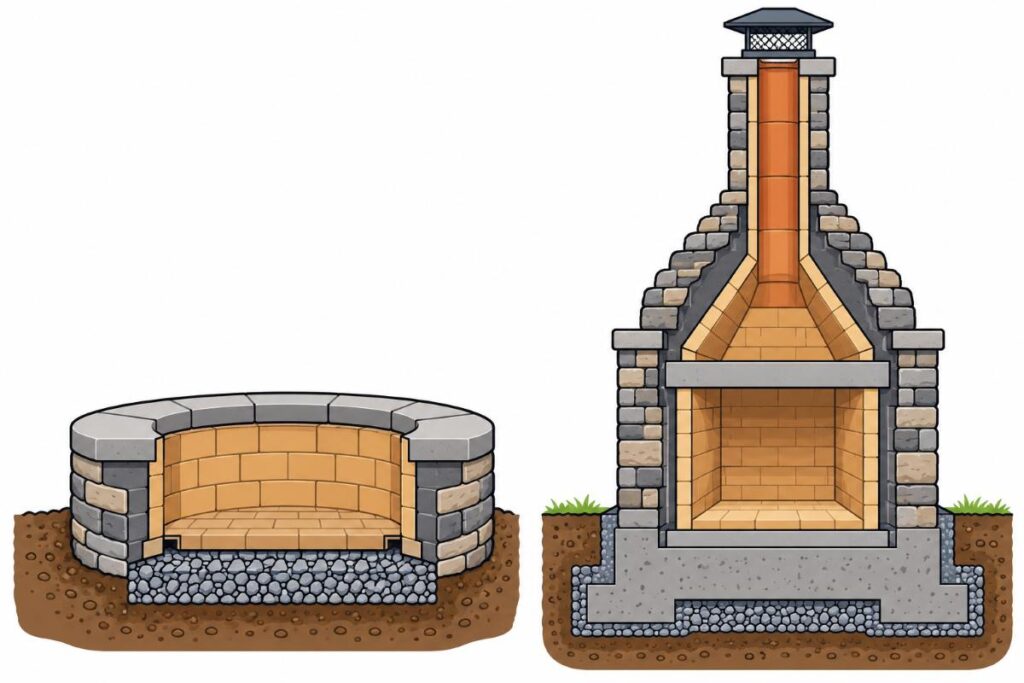
A fire pit is an open hearth that radiates heat in every direction to a surrounding seating ring. An outdoor fireplace encloses the fire in a firebox whose chimney pulls smoke upward and sends heat forward to one seating side. The table below sets the attributes every later section builds on.
| Attribute | Fire pit | Outdoor fireplace |
|---|---|---|
| Structure | Open ring or bowl, in-ground or seat-height, set on a compacted base. No chimney. | Firebox (the chamber that holds the burning fuel), smoke chamber, chimney, and cap, built in full masonry or dropped in as a modular fireplace kit, on a footing. |
| Fuel classification | A wood pit burns as a recreational fire; a gas pit burns as a listed decorative gas appliance run to its listing and the manufacturer instructions. | A wood fireplace holds its fire in the firebox, so it falls outside the recreational-fire definition; a gas fireplace is a listed gas appliance. |
| Fire code classification | Open wood fire: keep 25 ft from a structure or combustible material (IFC Section 307.4.2, 2012 IFC). A fire bowl counts as a portable outdoor fireplace at 15 ft (IFC Section 307.4.3). | Fuel contained in an outdoor fireplace is excluded from the recreational-fire definition (City of St. Louis Ordinance 70932, eff. 05/02/2019), so the 25 ft open-fire rule does not apply. |
| Heat direction | Radiates 360 degrees to a full seating circle. | Reflects off the firebox walls and projects forward to one seating side. |
| Smoke path | Rises off the open fire at seat level and shifts with the wind. | Drawn up the chimney and released above seat level, away from the seating area. |
| Fuel fit | Wood or gas. Gas suits a pit where smoke and embers are the main concern. | Wood suits the chimney, which carries smoke and sparks up the flue; gas runs off a natural-gas line or a propane tank for a no-ember burn. |
| Foundation | Compacted aggregate base or patio slab under the ring. | Concrete or solid masonry footing at least 12 inches thick, projecting at least 6 inches past the fireplace on all sides, below frost depth (IRC Section R1001.2, 2012 IRC). |
| Footprint and seating layout | Needs open space on every side for a full seating ring. | Sits at one edge and needs seating room on its front side only. |
How Do St. Louis Fire Rules Treat Fire Pits and Fireplaces?
Three rule layers decide where a fire feature can legally sit in Greater St. Louis. The first is the model code. The International Fire Code sets the base definitions and distances every local rule builds on. On top of it, the City of St. Louis adds its own recreational fire ordinance, and each St. Louis County municipality or fire protection district sets separate rules.
Does the 25-Foot Fire Code Setback Apply to an Outdoor Fireplace?
An open wood fire pit must sit at least 25 feet from any structure or combustible material. That rules out a pergola or covered patio. A chimneyed outdoor fireplace falls outside the recreational fire definition, the 3-foot-wide, 2-foot-high open burn the fire code treats as a recreational fire (2021 IFC Section 307.4.2). A fire bowl is a portable outdoor fireplace and needs 15 feet under Section 307.4.3.
What counts as a structure is broader than the house. A pergola, a covered porch, or a wood fence all read as a structure or combustible material for an open wood pit. A gas fire pit is different again: its side and overhead clearances come from its listing and the manufacturer instructions, and the local fire official decides whether the 25-foot rule reaches it.
What Are the City of St. Louis Recreational Fire Rules?
In the City of St. Louis, a wood recreational fire must sit at least 12 feet from any structure under Ordinance 71260 (effective January 18, 2021). That ordinance cut the older 25-foot distance, and a pit inside 12 feet cannot run as a recreational fire where it stands.
The City also limits the fire itself, not just where it goes. Three limits shape how a wood pit gets designed:
- The fuel area tops out at 30 inches across and 18 inches high, so it caps the burn zone, not the outer stone ring you sit around.
- Logs thicker than 4 inches across are barred, and untreated dimensional lumber is the only building material you may burn.
- The 12-foot distance is measured from structures, so a tight city lot often decides the pit’s spot before the design does.
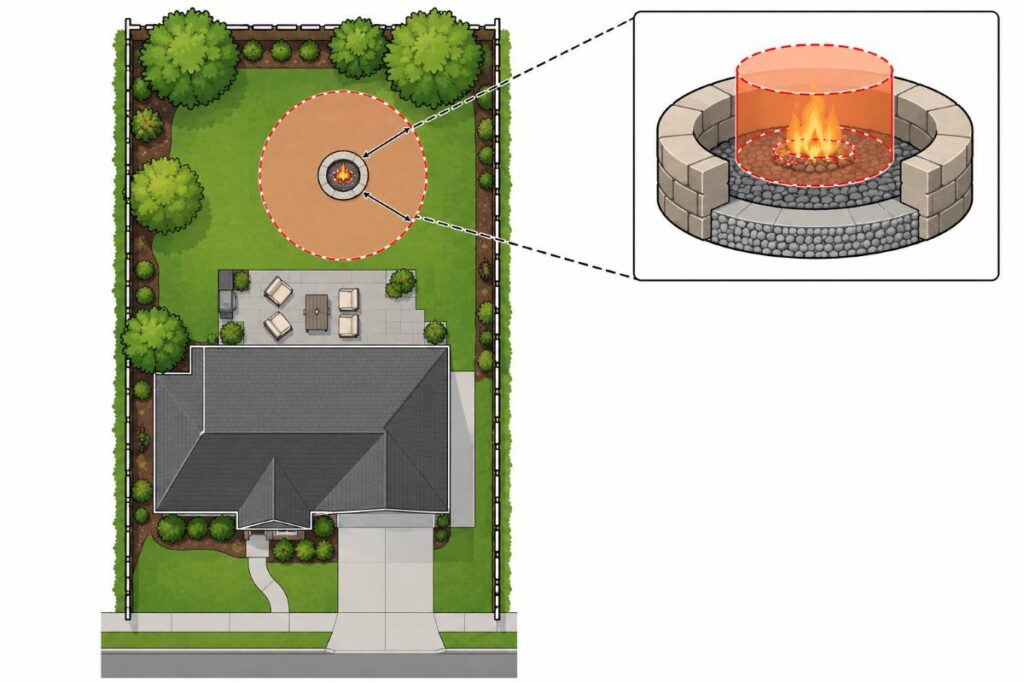
Inside 12 feet, a pit has two ways out. Move it, or build a chimneyed outdoor fireplace instead. The City’s recreational fire definition excludes fuel held in an outdoor fireplace, a portable outdoor fireplace, a grill, or a barbeque pit, so a fireplace is not bound by the 12-foot rule.
What Fire Pit Rules Apply in Kirkwood and St. Louis County?
St. Louis County sets no single countywide recreational fire standard. Each municipality or fire protection district writes its own, so the rule that governs a pit depends on which district the address sits in. Two worked examples show how far apart those rules can land:
- Kirkwood: the Fire Marshal or a designee must approve a recreational fire, requested by email, and only dry-seasoned wood may burn.
- Mehlville Fire Protection District, serving Oakville: recreational fires cap at a 3-by-3-foot base, 3 feet high, with no smoke or ash past the property line.
Both districts allow only untreated, seasoned dry wood, and that is where the agreement ends. One step applies anywhere in the County. Contact the fire authority that serves the address before siting a wood-burning pit, because the approval rule, the size cap, and the fuel rule change from one district to the next.
How Do Fire Pits and Outdoor Fireplaces Compare on Heat and Smoke?
Heat and smoke pull the choice in opposite directions. A fire pit spreads warmth to a full circle but lets smoke rise at head height. An outdoor fireplace does the reverse. It aims heat at one side and sends smoke up a chimney, away from the seating.
Which Puts Out More Heat, a Fire Pit or an Outdoor Fireplace?
A fire pit spreads radiant heat 360 degrees, so everyone in the seating circle gets roughly the same warmth. An outdoor fireplace works the other way. It reflects heat off the firebox walls and throws it forward, so the people facing the opening feel it most.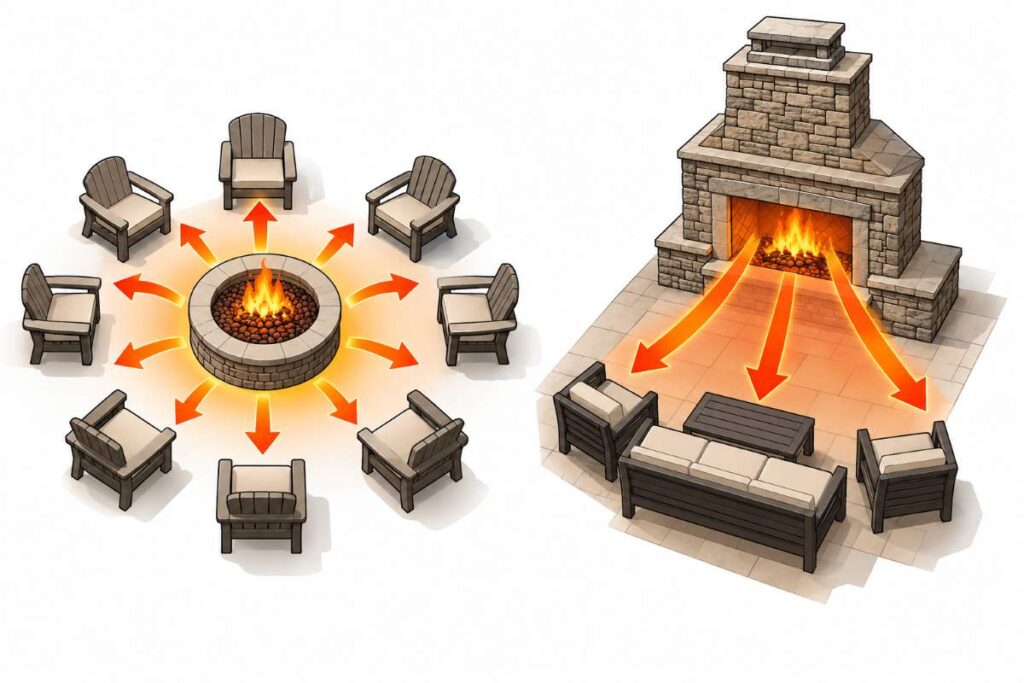
How much of that warmth actually reaches a person comes down to two things. One is how far back the seating sits. The other is how deep the firebox is, because a deeper box throws its heat farther forward.
On a gas unit, the burner sets the output, and output climbs with burner size. A few specifics decide the match:
- The burner’s BTU rating fixes how much heat a gas unit throws, and a larger burner carries a higher rating. Warming Trends Crossfire brass burners run from about 60,000 BTU on an 18-inch plate up to 560,000 BTU on the 60-inch model.
- A brass burner drops into a burner pan sized to the pit opening or firebox floor.
- The ignition is either match-lit, which you light by hand, or electronic, which starts at a switch.
Match the burner to the structure, not the other way around. A deep firebox wants a burner sized to its floor; an open pit wants one sized to its ring.
Does a Fire Pit or an Outdoor Fireplace Produce Less Smoke?
An outdoor fireplace puts less smoke at seat level, because its chimney draws the combustion gases up and releases them above where people sit. A wood fire pit has no flue. Its smoke lifts off the fire at head height, and a gust can carry embers downwind.
Lot size decides how much this matters. On a narrow City lot, a pit sits close to the house and the property line, so smoke reaches a neighbor fast. A larger County lot buys distance, and a gas fire pit avoids the issue by making no wood smoke. The Mehlville Fire Protection District puts that line in writing: a fire may not send smoke, ash, or particulate past the property line.
Which Fuel Works Best in a Fire Pit vs an Outdoor Fireplace?
Wood suits an outdoor fireplace, because the chimney carries smoke and sparks up and away. Gas suits a fire pit or a gas fire table wherever smoke and embers are the main worry. The table does the matching. It pairs each fuel to each structure and flags the legal and certification limits.
| Attribute | Wood fireplace | Wood pit | Gas fireplace | Gas pit |
|---|---|---|---|---|
| Smoke | Drawn up the chimney, away from seating. | Rises at seat level, shifts with wind. | None. | None. |
| Embers | Contained and carried up the flue. | Can drift on a gust. | None. | None. |
| Ignition | Match-lit by hand. | Match-lit by hand. | Match-lit or electronic. | Match-lit or electronic. |
| Legal fuel | Burn only untreated wood: wood that is not chemically preserved, painted, stained, or composited (10 CSR 10-6.045(2)(F)). | Same untreated-wood limit; Missouri DNR (PUB2047, 05/01/2020) notes recreational fires are allowed, and the City’s fuel limits apply inside City limits. | Natural gas or propane; no wood-fuel rule applies. | Natural gas or propane; no wood-fuel rule applies. |
| Certification | Not a listed gas appliance; follows fireplace and chimney construction rules. | Not a listed appliance. | Burner certified to ANSI Z21.97-2017 (R2022)/CSA 2.41, “Outdoor decorative gas appliances.” | Burner certified to ANSI Z21.97-2017 (R2022)/CSA 2.41, installed to the manufacturer’s clearances. |
| Utility hookup | None; burns cordwood. | None; burns cordwood. | Fixed natural gas line, such as Spire service, or a propane tank. | Fixed natural gas line, such as Spire service, or a propane tank. |
How Are Fire Pits and Fireplaces Built for St. Louis Freeze-Thaw?
A masonry outdoor fireplace needs a footing deep and wide enough to stay put through a Missouri winter. The residential code benchmark, IRC Section R1001.2 (2012 IRC), calls for a concrete or solid masonry footing at least 12 inches thick, extending 6 inches past the fireplace on every side and set below frost depth.
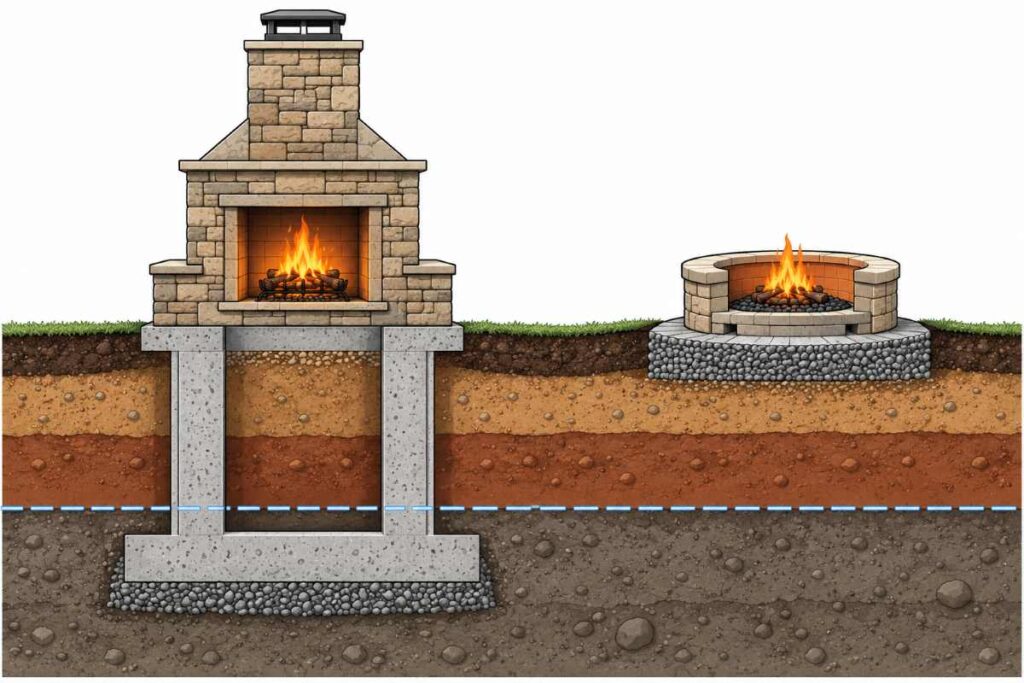
Whether that benchmark applies to a detached outdoor fireplace is the local building official’s call, not an automatic requirement. Confirm it before design starts.
Frost depth is not a single number across the metro. Jefferson County, under its adopted 2015 IRC, sets a 30-inch frost line depth, the minimum footing depth below finish grade (Table R301.2(1)). Arnold, St. Louis County, and the City of St. Louis set their own figures in their own adopted codes, so confirm the depth for the address with its building department before anyone pours a footing.
A fire pit is a different structural problem. Its low mass usually sits on a compacted aggregate base or a patio slab, so it does not need a deep footing the way a tall masonry fireplace does. Freeze-thaw protection comes instead from keeping water from pooling and freezing under and inside the structure. Three things handle that:
- A compacted aggregate base spreads the load and drains water away from the ring.
- A firebrick liner set in refractory mortar takes the heat and resists spalling, the surface flaking that freeze-thaw cycles cause in ordinary masonry.
- Drainage holes at the base course let water escape before it freezes and lifts the ring, the movement called frost heave.
Handled together, the base, the liner, and the drainage keep a pit stable through the freeze-thaw cycle without the deep footing a fireplace needs.
How Much Patio Space Does Each Fire Feature Need?
A fire pit needs open space on every side. It takes a full seating ring plus its fire code setback from any structure. That setback is 25 feet for an open wood fire under Section 307.4.2, and 12 feet inside the City of St. Louis under Ordinance 71260. An outdoor fireplace sits at one edge and needs seating room on its front side only.
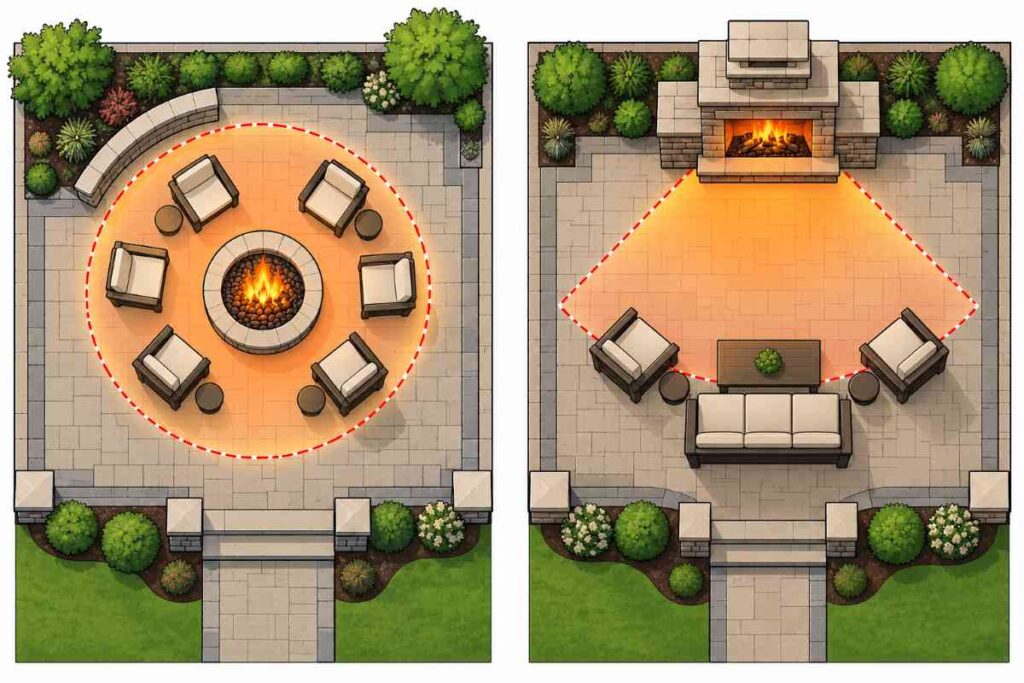
That difference decides which one a lot can hold. A fireplace fits a narrow lot where a pit’s ring and setback cannot. A few layout points follow:
- A fire pit needs a clearance zone wide enough for chairs on all sides, so the usable patio has to be larger than the pit itself.
- A built-in seat wall around a pit, often a short retaining-wall course, adds fixed seating and holds the ring’s edge without widening the footprint much.
- An outdoor fireplace at the patio edge can double as a privacy wall, screening one side from a neighbor while it anchors the seating.
The pit wants a yard; the fireplace wants an edge. Match the feature to the shape of the space before the look.
Do St. Louis Homeowners Need a Permit for a Fire Pit or Fireplace?
Before building, get two separate answers, because a fire feature can trigger two different reviews. The building department of the municipality where the address sits rules on construction: the masonry footing and its inspection, the chimney, and any new gas piping. The local fire authority rules on the fire itself, meaning whether you may burn wood in the feature. In Kirkwood, a Fire Marshal or designee approves it.
The two reviews answer different questions. Construction review checks whether the structure is built to code; fire-use approval checks whether the burning is allowed where it sits. Permit triggers vary by municipality, so confirm both with the building department and the fire authority for the address before work starts.
How Much Does a Fire Pit Cost Compared With an Outdoor Fireplace?
An outdoor fireplace costs more to build than a fire pit. The gap comes from structure, not finish. A fireplace adds a below-frost footing, a firebox, a chimney, and far more masonry than a pit needs. A fire pit’s cost is set mostly by its base, its liner, and any gas-line run.
Four drivers move the number most, in rough order of impact:
- The footing. A fireplace needs a footing below frost depth, at least 30 inches in Jefferson County; a pit sits on a compacted base.
- Chimney height. A taller chimney means more masonry, more labor, and a bigger structure to tie together.
- Veneer type. Natural stone, manufactured stone, and segmental block each carry a different material and labor cost per square foot.
- Gas-line run. A longer run from the meter to the feature adds pipe, trenching, and connection labor, on a pit or a fireplace.
A fireplace also takes longer to build than a pit. The reason is the footing. It has to be dug below frost depth, poured, and cured before the masonry starts, and the chimney adds courses a pit never has. A pit skips that, so it reaches first fire sooner.
Should You Build a Fire Pit or an Outdoor Fireplace?
Build a fire pit for a social, 360-degree gathering spot on an open yard with room for its setback. Build an outdoor fireplace when the lot is tight, when smoke or wind is a concern, or when you want a vertical focal point that screens one side of the patio.
A fire pit fits when the yard and the use favor it:
- An open yard with room for the seating ring plus the setback: 12 feet from structures in the City of St. Louis, or 25 feet under the model fire code.
- Groups that gather in a circle rather than facing one direction.
- Neighbors far enough off that smoke drifting at seat level is not a problem.
- A spot where wood setbacks will not fit, which a gas pit can often solve.
An outdoor fireplace fits the opposite conditions:
- A narrow City lot where a pit’s ring and its setback cannot fit.
- A patio exposed to prevailing wind, where a chimney and a solid back wall steady the fire.
- Neighbors close enough for smoke complaints, or a district that bars smoke past the property line.
- A need to screen one side of the patio and give the seating a focal wall.
- An outdoor kitchen already in the plan, where the fireplace can share the gas line.
The yard decides as much as the taste does. Read the lot first, then the setback, then the way the space will be used, and the right feature usually names itself.